


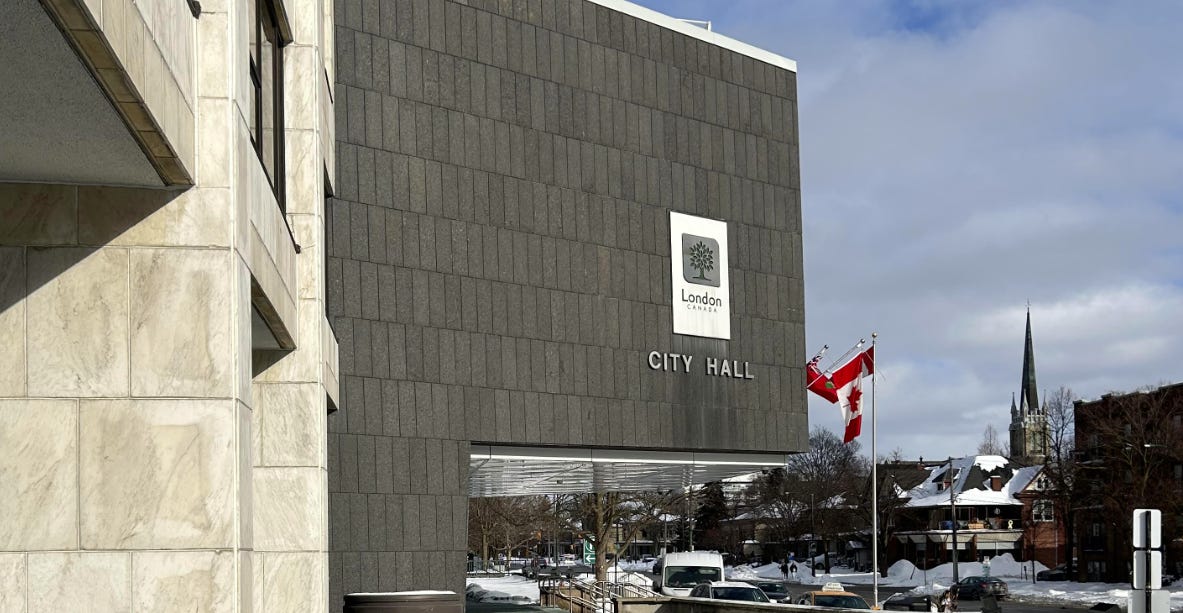
Hello everyone and happy Saturday!
Let’s talk about real democracy in action, and how we, as citizens of Canada’s London, might seek to engage with the processes of decision-making in local government. Wholesome, eh? Thanks for being engaged citizens, with informed opinions, and paying attention to goings-on at City Hall and beyond.
You’re not the only ones1 with an interest, of course. Fortress Dufferin2 is a place with a lot of information flowing around and - crucially - some formal processes designed to help us make our opinions heard. Everyone there works for us, of course, because we’re the taxpayers. And, there is such a thing as the City Hall Bubble, so it’s important our decision-makers have a good understanding of people’s opinions throughout their time in office.
If you want to join the conversation, you can find out more on the City’s website here. It amounts to two main options: speak at a Public Participation Meeting or get on an agenda, by direct submission or perhaps by persuading a council member to take up your cause3. Don’t just show up and start shouting. They chuck you out for that.
And, as we continue this magnificent municipal luge all the way to Election Day, people are providing full-throated opinions. You can find dozens of public submissions on last week’s Full Council agenda4, and several already added and more coming in for next week’s Community and Protective Services agenda. Meanwhile, the Planning and Environment Committee has no fewer than 10 PPMs, so that one isn’t ending this side of Wednesday week.
In my experience, when people take the trouble to show up, it means they have something to say. I think we’re seeing a trend that will continue through 2026 until the day when people5 really do have full participation in local democracy: Election Day, on October 26. Until then, we have months of decisions to get through and the pace isn’t slowing.
So here, if you want to dip in, is a large selection of comments sent to City Hall recently. All of them are recent, and as usual you shouldn’t read them all. But you might scroll through for insight into why people showed up.
Vox populi, vox dei.

Public Submissions to London City Council
Note these were only the submissions received between the committee stage and Full Council. There were many more sent to committee. Prepared with A.I. support.
File OZ-25152: 550 Ridout Street North / 82–90 Kent Street
This is the York Developments 30-storey tower approved by Full Council on Tuesday.
N. Napolitano
N. Napolitano, a London resident who submitted comments regarding planning file OZ-25152, opposed the proposed redevelopment at 550 Ridout Street North and 82–90 Kent Street. The submission argues that the development appears to focus on luxury rental housing while broader housing affordability challenges persist in the city. Napolitano questions why developers are able to seek zoning exceptions while environmental sustainability measures—such as renewable energy use or more self-sufficient building designs—are not mandated in the same way. The letter frames the issue as both an environmental and housing policy concern, suggesting the City should require stronger sustainability measures and ensure that redevelopment projects better reflect the needs of residents facing economic pressure and rising housing costs.
Dr. Daniel Robinson
Dr. Daniel Robinson, a professor at Western University and a resident of the North Talbot neighbourhood, submitted a detailed letter opposing the proposed development. Robinson argues that the redevelopment would demolish approximately forty existing rental units that currently provide relatively affordable housing and replace them with a significantly larger luxury project. He questions whether the benefits of the proposed tower justify the loss of existing housing stock and raises concerns about the scale of the development compared with existing zoning limits in the area. Robinson’s submission also touches on broader downtown conditions, suggesting that issues related to safety and neighbourhood stability should be considered when evaluating major new developments in the area.
Maria Rejak
Maria Rejak, a London resident who submitted written comments to Council, criticized the decision by the Planning and Environment Committee to move the development forward despite a recommendation from City planning staff to refuse the application. Rejak argues the project does not align with planning frameworks including the London Plan and the Provincial Planning Statement. Her letter highlights the difference between existing zoning allowances—approximately 24 metres in height—and the proposed building, which would be significantly taller. Rejak also emphasizes concerns about the loss of affordable rental units and warns that removing such housing without replacement could worsen housing instability. Her submission calls on Council to follow staff planning advice and reconsider the approval of the project.
Roslyn Colenutt
Roslyn Colenutt, a condominium owner living near the proposed development site, submitted a letter expressing concern about the impact of a 30-storey tower in the neighbourhood. Colenutt argues that the project would dramatically exceed the scale anticipated under current planning rules and could create significant traffic pressure on surrounding streets. She also raises questions about emergency vehicle access in an area that already experiences congestion. In addition to transportation concerns, Colenutt emphasizes the social impact of demolishing existing rental units that currently house residents at lower rents. Her submission asks Council to respect the existing planning framework for the area and to consider the cumulative effects of high-rise development on nearby residents and infrastructure.
Mary Blake Rose
Mary Blake Rose, a former resident of the buildings proposed for redevelopment, wrote to Council to highlight the human impact of redevelopment decisions. Rose states that tenants living in the buildings face uncertainty about where they will live if demolition proceeds. She argues that the current rental market in London is highly competitive and that displaced tenants may struggle to find comparable housing at similar rents. Rose urges Council to require the developer to provide clear relocation plans, fair compensation, and meaningful protections for current tenants. Her submission frames the redevelopment not only as a planning issue but also as a question of fairness and housing security for residents who could be displaced by the project.
Louise White
Louise White, a long-time resident of the Talbot neighbourhood, expressed concern about the height and scale of the proposed development. White argues that extremely tall buildings create safety considerations related to fire response, noting that aerial ladder equipment has limits when responding to high-rise emergencies. She also raises urban design concerns including potential wind impacts, reduced sunlight at street level, and changes to the character of the surrounding neighbourhood. White’s submission emphasizes that planning decisions should balance development with safety and neighbourhood livability. She urges Council to consider the broader urban design implications of allowing buildings significantly taller than what current planning documents envision for the area.
Jill Jacobson
Jill Jacobson, a long-time renter in London, shared her personal experience navigating the city’s rental market after being forced to move during building renovations. Jacobson explains that finding affordable housing proved extremely difficult and describes the stress and uncertainty that renters face when units are removed from the market. She argues that demolishing rent-controlled buildings for new luxury developments could worsen housing insecurity and potentially contribute to homelessness. Jacobson’s submission focuses on the lived experience of tenants and urges Council to weigh the social impact of redevelopment decisions on renters who depend on existing affordable units.
Anne Young
Anne Young, a resident of the nearby Blackfriars neighbourhood, submitted comments expressing concern that the proposed tower would alter the character of the surrounding community. Young argues that large developments can lead to displacement of existing residents and change the scale and atmosphere of established neighbourhoods. She also raises concerns about increased traffic, congestion, and pressure on local infrastructure. In her submission, Young questions whether luxury high-rise developments are the best way to address housing needs in the area. She encourages Council to consider alternatives that would support affordability and maintain the existing community fabric while still allowing thoughtful development.
Obidike Juwah
Obidike Juwah, a London resident who provided a detailed planning-focused submission, argues the proposed development does not comply with multiple provisions of the London Plan. Juwah states that the project exceeds height limits intended for the area and could significantly increase traffic volumes during peak periods. His letter also addresses issues related to streetscape design and neighbourhood transition between downtown and adjacent residential areas. Juwah emphasizes that planning policies are intended to guide consistent development decisions and argues that approving projects that exceed those guidelines undermines the integrity of the planning framework. His submission asks Council to carefully evaluate whether the proposal aligns with established planning policies.
Colin Fitchett
Colin Fitchett, a long-time London resident who submitted written comments to Council, expressed concern about the demolition of existing buildings that currently provide affordable rental housing. Fitchett argues that replacing these units with higher-priced apartments may reduce the availability of housing for residents with moderate incomes. He also raises concerns about the potential loss of older buildings that contribute to the neighbourhood’s historic character. Fitchett’s submission highlights traffic concerns in the area, particularly near Blackfriars Bridge, and suggests that increased density could place additional pressure on already busy routes. His letter encourages Council to consider the cumulative impacts of development decisions on housing availability and neighbourhood identity.
Carol Hunter
Carol Hunter, a downtown London resident, wrote to Council about the impact of high-rise development on pedestrian conditions. Hunter describes strong winds that can occur near tall buildings and notes that some intersections in the downtown core already experience what she describes as “wind tunnel” effects. She argues that additional towers could intensify these conditions and make walking uncomfortable or potentially hazardous during certain weather conditions. Hunter’s submission highlights the importance of considering microclimate effects—such as wind patterns—when approving new tall buildings. She encourages Council to ensure that urban design considerations are fully evaluated before permitting additional high-rise construction.
Dave M (Ward 13)
Dave M, identifying himself as a resident of Ward 13, submitted a letter criticizing what he views as the city’s increasing reliance on luxury high-rise development. Dave argues that many new buildings downtown are priced beyond the reach of average residents and therefore do little to address housing affordability. He states that the focus on luxury projects may contribute to widening economic gaps between residents who can afford new developments and those who cannot. His submission calls on Council to place greater emphasis on affordable housing initiatives and to ensure that redevelopment projects contribute to addressing the broader housing challenges facing London residents.
David Adams
David Adams, a condominium owner living on Ridout Street, submitted a letter questioning the process used to advance the proposed development. Adams notes that City planning staff recommended refusing the application and asks why Council would move forward despite that advice. His submission also raises concerns about the perception of conflicts of interest related to political donations associated with individuals connected to the development. Adams argues that transparency and adherence to professional planning recommendations are essential to maintaining public confidence in municipal decision-making. His letter urges Council to carefully consider both planning advice and public trust when evaluating the proposal.
Sari Belzycki (represented by BLG / Lee English)
Neighbouring property owner Sari Belzycki, through legal representation from Borden Ladner Gervais and lawyer Lee English, submitted a formal letter opposing the development. Planning consultant Allan Ramsay provided analysis on Belzycki’s behalf, arguing the proposed 30-storey tower would create privacy impacts, overshadow neighbouring properties, and disrupt the intended transition in building height between the downtown core and adjacent residential areas. The submission states that the proposal is inconsistent with the London Plan and does not adequately respect the scale of surrounding development. Belzycki’s letter asks Council to reject the application and ensure future proposals follow established planning guidelines.

Item: Driveway Expansion / Parking Policy (PEC 4th Report, Item 4.1)
This was also covered in my Full Council roundup this week.
Sandy Levin6 (Orchard Park / Sherwood Forest Neighbourhood Association)
Sandy Levin, president of the Orchard Park / Sherwood Forest Neighbourhood Association, submitted a letter asking Council to defer a proposed by-law amendment that would allow wider residential driveways across the city. Levin argues that expanding driveway capacity may conflict with long-term transportation goals, particularly planned improvements to public transit such as Bus Rapid Transit (BRT). The letter suggests that increasing driveway space could encourage greater reliance on private vehicles rather than supporting transit use. Levin also raises concerns about the impact of the policy in neighbourhoods near Western University, where many students already receive transit passes as part of their tuition. The submission recommends either delaying the by-law amendment or creating exemptions for near-campus neighbourhoods.
Neil P
Neil P, a London resident who submitted comments on the driveway policy, argues that increasing allowable driveway sizes would reduce green space and increase environmental impacts in residential neighbourhoods. His letter suggests that larger driveways would contribute to stormwater runoff and remove landscaping that currently helps absorb rainfall. Neil proposes that the City instead expand residential street parking permit programs, which he says could generate municipal revenue while also acting as a form of traffic calming. According to the submission, parked vehicles can narrow roadways and reduce vehicle speeds, making streets safer for pedestrians and cyclists. The letter encourages Council to consider environmental and safety impacts when evaluating the proposed by-law amendment.
Martin Horak
Martin Horak, Associate Professor of Political Science at Western University and Director of the Centre for Urban Policy and Local Governance, submitted a research-based letter opposing a return to a citywide minimum requirement of one parking space per residential unit. Horak explains that academic research consistently shows parking minimums increase housing construction costs and discourage adaptive reuse of existing buildings. He argues that mandatory parking requirements can also undermine efforts to encourage public transit use. Horak recommends that Council collect more detailed data on actual street parking demand and availability before implementing policy changes. He also suggests that parking policies could be tailored to specific neighbourhoods, particularly those with good transit access.
Susan Bentley (Broughdale Community Association)
Susan Bentley, president of the Broughdale Community Association, submitted comments regarding the driveway policy with particular attention to neighbourhoods near Western University. Bentley argues that allowing wider driveways across the city could worsen parking pressures in near-campus areas that already experience high levels of rental housing and density. Her letter states that increased driveway capacity could encourage additional vehicles in neighbourhoods that already struggle with congestion and on-street parking demand. Bentley recommends delaying the policy change for several years to evaluate how transportation initiatives—including improvements to transit—affect parking needs. Alternatively, she suggests that Council consider creating exemptions for neighbourhoods with unique parking pressures.
A Valastro (Ward 13)
A Valastro, identifying themselves as a resident of Ward 13, submitted comments arguing that expanding driveway sizes is not the most effective way to manage parking demand. Valastro states that larger driveways would remove green space from residential properties and could increase stormwater runoff into municipal drainage systems. The submission proposes expanding residential street parking permit programs instead, suggesting that such programs could better balance parking demand while generating revenue for the City. Valastro also notes that permit systems allow municipalities to regulate parking more precisely and adapt policies to neighbourhood needs. The letter encourages Council to consider environmental and infrastructure impacts before approving the driveway amendment.
Item: Residential Rental Unit License Display
Skylar Mcfarlane (London ACORN – East of Adelaide Chapter)
Skylar Mcfarlane, a leader with the East of Adelaide Chapter of London ACORN, submitted comments supporting a requirement that Residential Rental Unit Licenses be publicly displayed and include permitted occupancy information. Mcfarlane argues that displaying licenses would help tenants verify whether a property is legally registered and compliant with municipal rules. The submission also notes that first responders could benefit from knowing the permitted occupancy of a building when responding to emergencies. Mcfarlane frames the proposal as a transparency measure that would empower tenants and prospective renters while improving accountability for landlords. According to the submission, the requirement would not create significant administrative burdens but could improve awareness of licensing standards across the city.
Susan Bentley (Broughdale Community Association)
Susan Bentley, writing in her role as president of the Broughdale Community Association, submitted additional comments related to rental housing oversight. Bentley suggests the City should ensure that basic landlord contact information is accessible to neighbours and tenants. She proposes an online registry or publicly available email contact for licensed rental properties so residents can report issues such as garbage problems, maintenance concerns, or damage affecting neighbouring properties. Bentley argues that improved transparency could help resolve problems more quickly and reduce tensions between tenants, landlords, and nearby residents. Her submission frames accessible contact information as a practical step toward improving accountability and communication in neighbourhoods with significant rental housing.
Christine Mettler
Christine Mettler, a London tenant, wrote in support of requiring Residential Rental Unit Licenses to be visibly displayed on rental properties. Mettler argues that tenants should be able to easily identify their landlord and verify that a building complies with licensing requirements. She also suggests that displaying permitted occupancy levels would help tenants determine whether a property is being used in accordance with City regulations. In her submission, Mettler encourages Council to consider expanding the licensing framework to cover larger corporate landlords as well. She states that stronger oversight could help ensure consistent standards across the rental market and improve transparency for people searching for housing.
Item: Old East Village BIA Reimbursement Request (Cleaning and Graffiti Removal Program)
This was also covered in my Full Council roundup this week.
Bryan Gloyd (Aeolian Hall Musical Arts Association)
Bryan Gloyd, General Manager of Aeolian Hall, submitted a letter supporting the Old East Village BIA request for reimbursement related to private property cleaning and graffiti removal. Gloyd notes that the Aeolian hosted 24,717 attendees across 160 events in 2025, making it a significant cultural venue in the neighbourhood. He writes that conditions in the surrounding streets—such as graffiti, litter, vandalism, and property damage—directly affect the experience of patrons attending events. The letter states that the BIA’s cleaning and graffiti removal program has helped maintain a sense of safety and confidence in the area. Gloyd argues that maintaining a clean and welcoming environment benefits not only the venue but also the broader economic and cultural vitality of Old East Village.
Kevin Morrison (Old East Village BIA)
Kevin Morrison, Executive Director of the Old East Village Business Improvement Area, submitted a formal request asking the City to reimburse $14,152.33 spent on private property cleaning and graffiti removal services between May 1 and December 31, 2025. Morrison explains that the BIA extended the program to support several non-profit organizations in the district, including Banting House, Palace Theatre, Clayworx Ceramic Arts and Learning Centre, and Aeolian Hall. The services included removing garbage and debris, safely collecting needles and drug paraphernalia, cleaning biohazards, and removing graffiti. Morrison states that the BIA’s 2026 budget does not include funding to continue this program and asks Council to both reimburse the past expenses and explore a sustainable long-term framework for addressing these issues.
Steph Molloy (Palace Theatre Arts Commons)
Steph Molloy, Vice-Chair of the Palace Theatre Arts Commons (PTAC), submitted a letter supporting the BIA reimbursement request and describing operational challenges faced by the theatre. Molloy explains that a newly formed board took over the organization after the previous board resigned and has since raised approximately $50,000, expanded membership, and recruited new volunteers. Despite these improvements, the theatre continues to deal with external issues such as garbage, abandoned belongings, encampments, and biohazards around the property. Molloy writes that volunteers and board members have had to manage tasks such as snow removal and cleanup of hazardous materials, which the organization is not equipped to handle. She asks the City to consider assuming responsibility for these services.
Grant Maltman (Banting House National Historic Site)
Grant Maltman, Curator of Banting House National Historic Site, submitted a letter supporting the BIA reimbursement request and describing the importance of the cleaning program to the historic site. Maltman states that Banting House receives more than 3,000 visitors annually, with over half traveling from outside London. He explains that BIA assistance included removing needles, drug paraphernalia, biohazards, and graffiti from the property. Maltman notes that the site’s operating budget is limited and that the program represented roughly 10 percent of the organization’s budget, making it difficult to absorb the costs now that the program has ended. He argues that continued support is essential to maintaining a safe environment for visitors and preserving the heritage property.
ends ends ends phew
Here is the trailer for the popular film Mad Max III: Beyond Thunderdome.
I know there’s a bucketful of other ways to engage with City Hall; I’m talking about council’s public decision-making process here, which is an acute process generating most of the public discourse related to our municipality.
You can, but you absolutely should not. Don’t worry, I’ve got you.
Well, citizens. Not everyone. Value your vote, folks.
Sandy Levin is a former city councillor.