


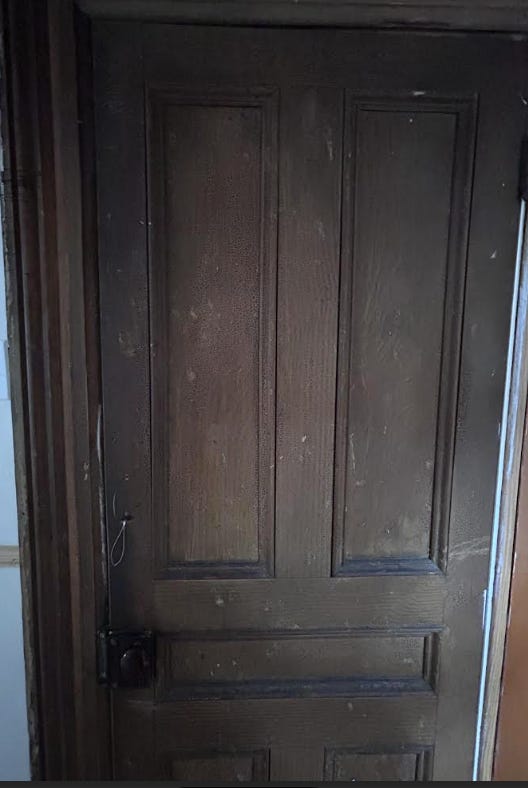
Follow me on a journey into my slightly-scary basement1, which is much nicer since the contractors left and I began painting every surface within reach and a few more besides. This is, of course, London, Ontario, where the yardwork, bugs and construction traffic are but the suspected susurrations2 of a summer to come and, for now, going outside again doesn’t seem too bad an idea, actually. Hello! I think it’s still a bit cold sometimes.
Here at London City Hall Notes… <holiday mode> I’m Mike, this is local news curated; paying attention does you credit. Public interest journalism, communications principles, yadda yadda, jokes in the footnotes, tell your friends please etc. and we are out. </holiday mode>
Happy long weekend! This week, I only managed one post because we had just one City Hall meeting, (as well as your ROUNDUP here) so I will try to make up for it with this. Scroll down for nostalgia, deja vu, and a creeping sense that we’re trapped in a Matrix of some kind3. Tell me if you like it, because there are no City Hall meetings next week so I could do a bit more, or similar.
Time travel time
About 13 years ago, I was a daily news reporter for the Metro London, making connections and tell stories around London (which sounds much like now, hmmm). And, I kept some mementoes in my basement. Let’s head through the scary door for a quick peek.
You find a cupboard. Will you open it Y/N?

What’s that? A pile of newspapers? Let’s delve in.
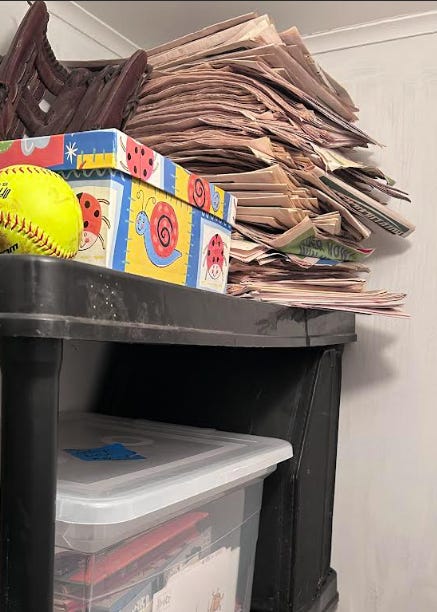
And what have we found? Only a great big pile of stories from 2013 (give or take a year), when we were talking about much the same issues. So, without dipping in very far at all, I pulled out three good stories that I wrote back then and I feel are still relevant in 2026.
Each time, I have used an A.I. to create a transcript, so I’m open to corrections. And, on a legal note, each of these images is a photograph I took and therefore my art; you may note the subtle nuance of the crappy lighting, complete with shadows of my own arm and phone. This is my signature style and I am proud of it.
If Roy Lichtenstein can get away with copying Russ Heath4, this works too.
Dramatis personae
Here’s who was on council back in 2013, before David Bowie died and the world consequently went to hell:
Mayor
Joe Fontana
Councillors (by ward)
Ward 1 – Bud Polhill
Ward 2 – Bill Armstrong
Ward 3 – Joe Swan
Ward 4 – Stephen Orser
Ward 5 – Joni Baechler
Ward 6 – Nancy Branscombe
Ward 7 – Matt Brown
Ward 8 – Paul Hubert
Ward 9 – Dale Henderson
Ward 10 – Paul Van Meerbergen
Ward 11 – Denise Brown
Ward 12 – Harold Usher
Ward 13 – Judy Bryant
Ward 14 – Sandy White
And I think that’s all you need to know. Come with me back in time5, etc., etc., wavy line effects are happening in your mind now
Graffiti cleanup and the urban environment
Just like a classic black shirt6, civic pride will never go out of style. Here’s a great front page that conjures memories of photography under a bridge in the northwest of town. What larks!
Let’s go!
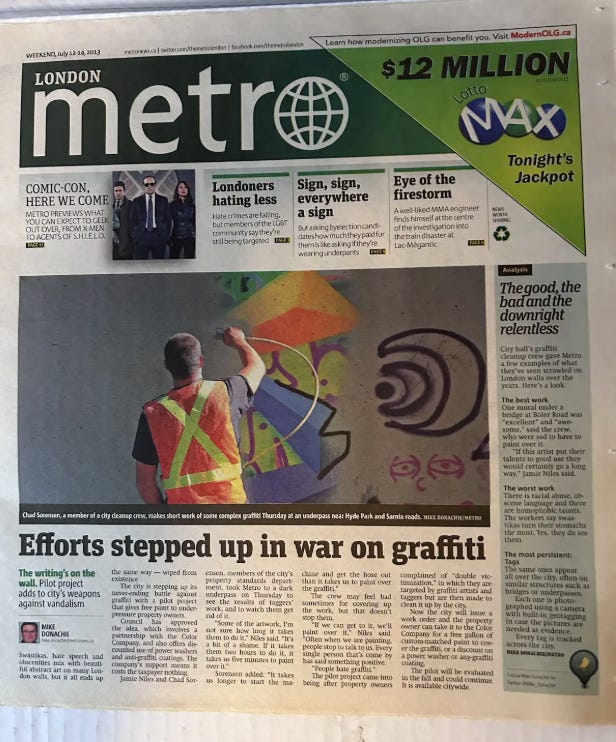
Efforts stepped up in war on graffiti
The writing’s on the wall Weapons adds to city’s war against vandalism
MIKE DONACHIE
Sometimes it comes off as abstract on many levels: from walls, but it all ends up costing taxpayers nothing.
It’s always the same way — wiped from the same walls, but neverending battle against graffiti in London. The city sprays over it with matching paint — and the problem is neverending.
The city is now taking new steps to try to reduce it.
On Thursday, the city unveiled its new graffiti management strategy, which includes new tools and increased enforcement.
Graffiti vandals have long been a thorn in the side of the city, costing thousands of dollars in cleanup and leaving property owners frustrated.
City officials say they are stepping up enforcement, including new bylaws and stricter penalties.
The city is also encouraging residents and businesses to report graffiti quickly, so it can be removed before it spreads.
Officials say graffiti tends to attract more graffiti if left untreated, making rapid response critical.
The city has also increased its use of surveillance and enforcement tools to catch offenders.
“We want to send a clear message that graffiti will not be tolerated,” a city official said.
The effort will also include partnerships with community groups and property owners.
Residents are encouraged to take pride in their neighbourhoods and report vandalism when they see it.
London, Western University, and the local economy
This issue will also never go away, and it’s worth thinking about as you have a read of this old story. It’s amazing to think that so little has changed.

Hundreds of jobs, millions for economy (transcription)
London leading the way. Excited councillors endorse plans for medical-innovation network
MIKE DONACHIE
The first green light was given Monday for a project that some say could change London forever.
Two of the biggest players in the city — the hospitals and Western University — have taken the first step toward getting $10 million to create a new way of working together, making advances in medical science and creating hundreds of jobs.
The city hall spending, approved by a committee on Monday and headed to Tuesday’s council meeting for a final vote, would be spread over a decade.
It would be coupled with $10 million promised from Western University, which has committed to raising $10 million more.
The goal is to attract a combined $80 million to $100 million from multiple sources, officials said.
Leaders of the effort want London to lead the way, nationally and internationally, as a centre that can offer medical advances at every stage, from forming ideas through development and construction to final commercialization.
The city already has all the right elements, but this new plan is designed to create a formal network with a board of directors, leaders say.
It will create 350 jobs, adding $52.5 million to the city economy, councillors heard on Monday.
London is already doing well, Dr. Michael Strong, dean of Western University’s Schulich School of Medicine and Dentistry, told the committee.
Since 2008, for example, Western and the Lawson Health Research Institute have created $243 million in licensing income — the fourth-highest total in Canada — secured 151 patents and seen 18 spinoff companies create 40 jobs.
Imagine what the bigger partnership could do, he suggested.
“In the almost 30 years that I’ve been here, this is probably the most exciting thing that I’ve seen, short of the birth of my children,” Strong said.
And excitement was shared.
“This is an example of how the right people coming together at the right time can bring the energy that leads to something quite extraordinary,” Coun. Joni Baechler said.
The players
London Health Sciences Centre
St. Joseph’s Health Care London
Lawson Health Research Institute
Western University (Schulich School of Medicine and Dentistry, Robarts Research Institute and the faculties of health sciences and engineering)
The Forest City and its trees
Oh, this is a topper, isn’t it? Back then, we were worrying about tree canopy. I should really bring this up to date. If there’s enough interest, I might.
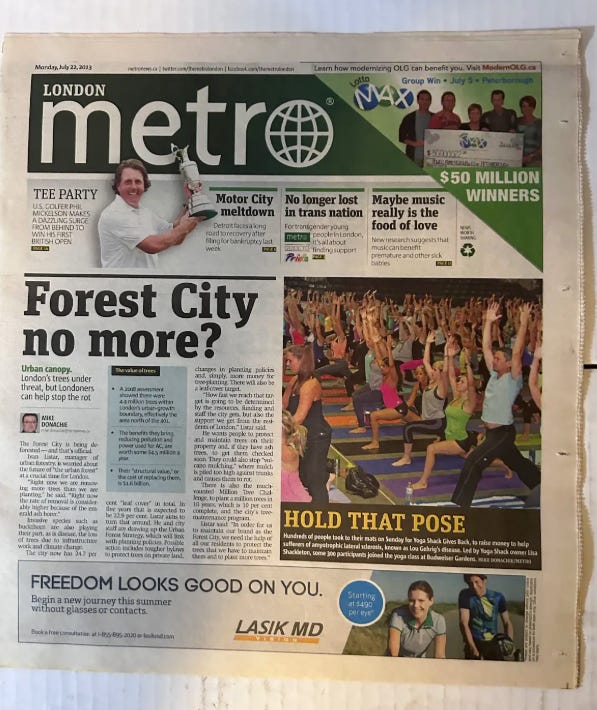
Forest City no more?
Urban canopy. London’s trees under threat, but Londoners can help stop the rot
MIKE DONACHIE
The Forest City is being deforested — and that’s official.
Ivan Listar, manager of urban forestry, is worried about the future of the urban forest at a crucial time for London.
“Right now we are removing more trees than we are planting,” he said. “Right now the rate of removal is considerably higher because of the emerald ash borer.”
Invasive species such as buckthorn are also playing their part, as is disease, the loss of trees due to infrastructure work and climate change.
The city now has 24.7 per cent “leaf cover” in total. In five years that is expected to be 22.9 per cent. Listar aims to turn that around. He and city staff are drafting up the Urban Forest Strategy, which will link with planning policies. Possible action includes tougher bylaws to protect trees on private land, changes in planning policies and, simply, more money for tree-planting. There will also be a leaf-cover target.
“How fast we reach that target is going to be determined by the resources, funding and staff the city gets, but also the support we get from the residents of London,” Listar said.
He wants people to protect and maintain trees on their property and, if they have ash trees, to get them checked soon. They could also stop “volcano mulching,” where mulch is piled too high against trunks and causes them to rot.
There is also the much-vaunted Million Tree Challenge, to plant a million trees in 10 years, which is 10 per cent complete, and the city’s tree-maintenance program.
Listar said: “In order for us to maintain our brand as the Forest City, we need the help of all our residents to protect the trees that we have to maintain them and to plant more trees.”
The value of trees
A 2008 assessment showed there were 4.4 million trees within London’s urban-growth boundary, effectively the area north of the 401.
The benefits they bring, reducing pollution and power used for AC, are worth some $4.5 million a year.
Their “structural value,” or the cost of replacing them, is $1.6 billion.
And that’s three, which is plenty
How did that go for you? Dizzy with perspective? It was a billion years ago, in the Before Times, so it can catch you out sometimes. And, I’d love to hear from you. Any interaction with this - a share, a like, a comment - helps local independent journalism, and our future plans.
Thanks for reading!
- Mike
PS: Fund the damn buses.
I love using this word in type because I can’t say it IRL. Hey - it’s not nice to mock the afflicted.
I love the Matrix but it was heavily influenced by The Invisibles. (Warning - comics link.)
Another comics link, but one hell of a point of view, and I dislike Roy Lichtenstein as a result. Click the image for the full story:

A Doctor Who reference would be fairly obvious, but I want to recognize my love for the show here and now. My Doctor was/is Davison (the Fifth Doctor). Who’s yours?