



Hello everyone - it’s time for some curated, bite-sized infodumping - because there have been events occurring, oh yes.
It may be March Break here in Canada’s London but City Staff have been beavering away on SO MANY THINGS that need to be crammed in before this council risks becoming a Lame Duck1, and BOOM here they are. Welcome to London, Ontario, where we ring in the New Year with 80s hair metal2 and the real sound of the city is Highbury Avenue going th’dum th’dum th’dum… for now. Read on, Londoners.
City Staff have just opened a hope chest full of dreams by filling the agendas of next week’s two big City Hall meetings - SPPC and ICSC, FYI, OK? - which you can find here but of course you should not do that, lest you slip into the arms of Mister Morpheus3 and never wake up again.
Instead, these are your basic, need-to-know Executive Summaries for Informed Citizens, to help you show good leadership in this here burg. I’m Mike, your communications lead, with curated information that I believe you should see. This is journalism in the public interest, following the principles of corporate communications: we do this together, and nobody’s farming us while we do it4. We follow the issues and keep the language neutral.
By my count, there are at least 15 viable stories in these two agendas so far5. The local media are working through them and so far we don’t have too much reporting, but I’ll likely have more for your ROUNDUP on Friday.
And off we go.
Strategic Priorities and Policy Committee
On Monday at 1. Full agenda is here, if you want more on any of this.
Summaries prepared by A.I. so the usual rules apply: check your facts before you act. Bots are useful but untrustworthy. And I will only use this tech carefully, sparingly and, I hope, ethically. In each case, I’m editing the piece before publication and any bold is my emphasis. I’m mostly setting the max word count at 120.
Skim them.
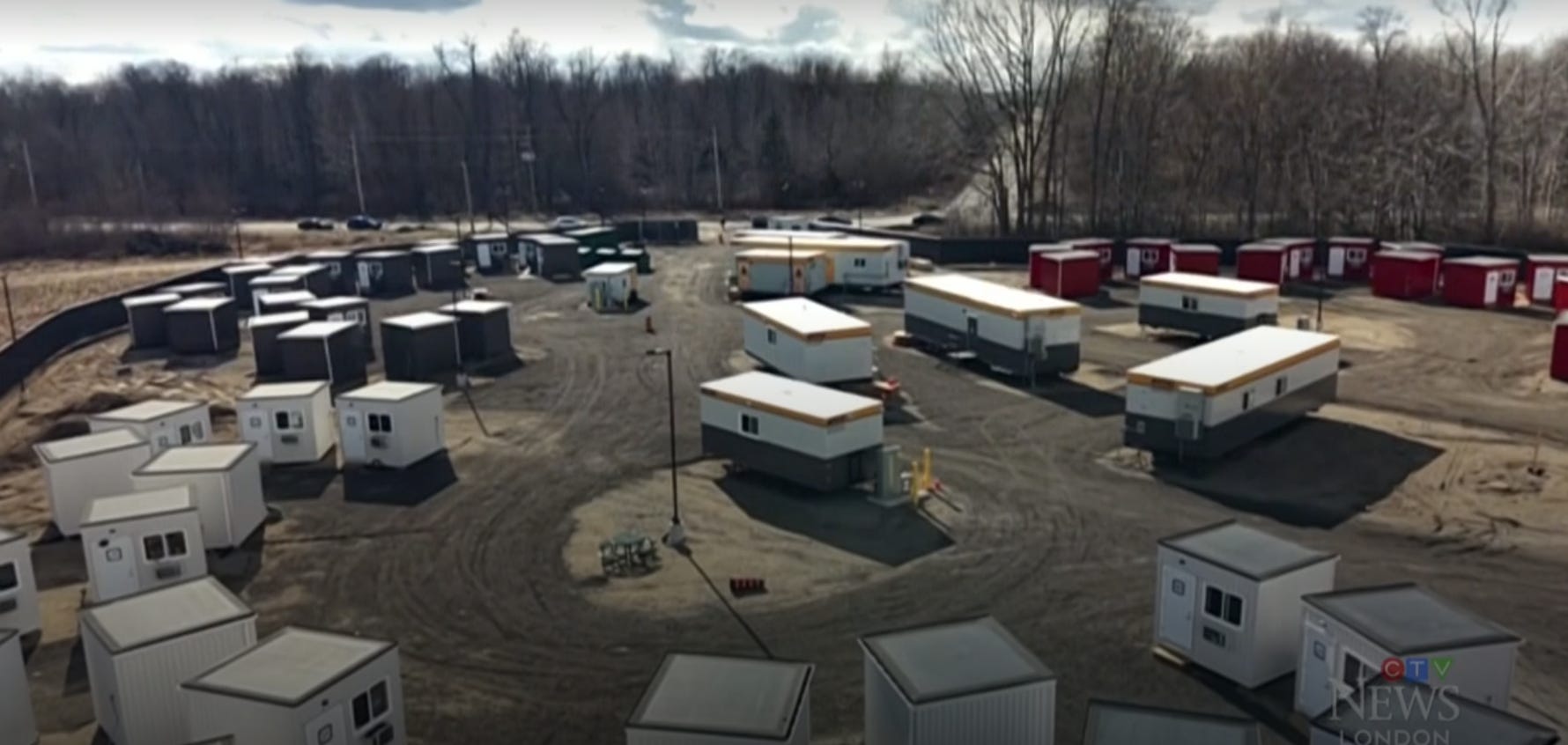
Cheese Factory Road homeless shelters (Item 2.1)
We start with CTV London, where the autoplay will drive you insane but the journalism makes it worthwhile, and Daryl Newcombe has provided this report about shelters for the homeless near the 401.
He quotes Mayor Josh Morgan thus: “The micro-modular shelter is working… People are finding indoor spaces. Certainly, there are still people outdoors, but [there’s] a big decline in the numbers of both encampments and people living unsheltered through the winter.”
Mayor’s affordable housing incentive program (Item 4.2)
The other big headline in this committee is the return of the Mayor’s election-year statement about making houses more affordable. A million years ago (actually five weeks, wow), I wrote this piece about the cut-and-thrust of it all.
Now here’s a summary of what’s come back to committee:
Staff report outlines a proposed Affordable New Home Ownership Incentive Program in response to Mayoral Direction 2026-001.
Program would provide a forgivable loan equal to 60% of development charges, with builders required to reduce prices by the remaining 40%. It applies to new homes priced at or below $630,646 and is capped at $5 million, supporting about 260 units.
Purchasers must occupy the home as a primary residence for two years or repay the loan. Staff recommend minimal eligibility restrictions to maximize uptake.
Analysis indicates stricter criteria reduce participation. Committee is asked to choose between the proposed program, revised criteria, or no action.
We’ll see how the conversation goes among members of council. This one will need unity.
Economic Development Strategy 2026-2030 (Item 4.1)
This is a really big deal, and I’ll dip into it again if nobody else does.
Staff report presents a draft Economic Development Strategy (2026–2030) and implementation plan for Committee review, with no approval requested at this stage.
The strategy sets a five-year vision, mission, and five strategic pillars focused on talent, investment, regional collaboration, transportation, and system coordination. It is based on research, economic analysis, and engagement with over 200 stakeholders (Executive Summary, pp. 1–3).
Implementation includes 30 actions with phased timelines, partners, and funding approaches, emphasizing coordination over new spending, with an estimated $4 million municipal investment over five years (p. 5).
Final revisions will follow Committee feedback, with endorsement planned for Q2 2026.
Special meetings with MPs and MPPs (Item 4.3)
Councillor Hadleigh McAlister has written a letter suggesting the committee start including more voices.
Letter proposes creation of regular intergovernmental meetings through the Strategic Priorities and Policy Committee.
Councillor Hadleigh McAlister states there is no current forum for local municipal, provincial, and federal representatives to coordinate on shared issues. The proposal cites increasing pressure on municipalities to address matters outside their jurisdiction.
The motion directs the SPPC Chair to convene biannual meetings with local MPs and MPPs, focused on sharing concerns, identifying available resources, and aligning advocacy.
Civic Administration would be directed to invite participants and prepare briefing materials on priority issues.
The letter is also to be received by the Committee.
Strategic advocacy - and conferences (Item 2.2)
Staff report provides an annual update on the Strategic Advocacy Framework, outlining government relations activity, including conference attendance and intergovernmental engagement.
City participation in conferences included the Association of Municipalities of Ontario (AMO), Rural Ontario Municipalities Association (ROMA), Good Roads, and Federation of Canadian Municipalities (FCM). Staff coordinated eight provincial delegation meetings at AMO and two at ROMA, along with additional meetings at Good Roads (p. 2).
Both elected officials (Mayor and Councillors) and staff (Government Relations team and Senior Leadership Team) attended. Staff provided briefing materials, coordinated meetings, and in some cases represented the City at association tables.
Attendance also extended to multiple municipal networks (AMO, ROMA, FCM, OBCM, BCMC, MARCO), with staff supporting or standing in where required.
Phew
And the other committee, if you’re still here. Stop grinding your teeth.
Infrastructure and Corporate Services Committee
On Tuesday at 1. Full agenda is here. This committee has even more material in it. Here are the summaries from the evil, soul-sucking bot.
Smart Commute program drives back into view (Item 4.2)
This is an interesting one. Staff tried to get this through council last month and were told it wasn’t a good use of money. They seem to be back with a new attempt, and a new PowerPoint deck.
Staff report and accompanying presentation provide additional justification for continuing the Smart Commute London program following earlier Council concerns.
Civic Administration is seeking authority to extend the City’s participation in the Smart Commute Association through a renewed MOU, at an annual cost of $15,000 (p. 6). The program, launched in 2024, currently includes 22 employer members representing about 28,000 employees and has logged 5,779 trips through its app to early 2026 (pp. 2, 5; presentation p. 3).
The program provides employers with tools to encourage carpooling, transit, cycling, and walking, including a trip-planning app, workplace programming, and incentives. It is positioned as a transportation demand management tool supporting broader City investments in rapid transit and active transportation (pp. 1, 3).
Staff note the program remains in a growth phase, with plans to expand employer participation and launch broader public promotion in 2026.
Committee is asked to receive the report and authorize execution of the MOU extension, with a follow-up report in 2027.

BetterHomes London - home energy retrofits (Item 2.9)
Staff report sets out the final design of the BetterHomes London program and seeks approval of required by-law templates and agreements to enable launch.
The program is expected to launch in spring 2026 and will support home energy retrofits through a combination of low-interest loans (2.5%) and performance-based grants. Loans are offered over 10-, 15-, or 20-year terms and repaid through a Local Improvement Charge added to property taxes (pp. 1–3).
Eligible participants can receive up to $40,000 in combined funding. Middle-income households (up to $115,000) may receive incentives starting at $2,500 for a 25% energy reduction, increasing to a maximum of $10,000 for net-zero performance (p. 1).
The program includes a concierge-style support service delivered by third parties, alongside City-administered financing and tax collection mechanisms.
Committee is asked to approve templates and delegate authority to staff to execute agreements.
New multi-use path planned for Meadowlily (Item 2.11)
Staff report marks completion of the Meadowlily Road Environmental Assessment and moves the project into the formal public review phase.
The study identifies a preferred servicing plan centred on a new sanitary pumping station on Meadowlily Road South, serving lands south of the Thames River only, with a connection to the existing system (pp. 3–4).
It also identifies a preferred multi-use pathway along the west side of Meadowlily Road, connecting the Meadowlily Bridge to the Citywide Sports Park and closing a gap in the active transportation network (pp. 3–4).
The study area covers about 167 hectares, with development currently limited by a lack of municipal servicing (p. 2).
Estimated costs are $6 million for sanitary infrastructure and $650,000 for the pathway, with construction timing tied to future growth planning (p. 6).
The report recommends filing the notice of completion and initiating a 30-day public review period.
Flood prevention programs: West London, Fanshawe Dam (Item 2.10)
We can expect this one to inspire discussion of the province’s recent changes to conservation authorities.
Staff report seeks approval for the Upper Thames River Conservation Authority (UTRCA) to deliver flood protection projects, with a total City contribution of $4.67 million.
Projects include reconstruction of phases 9–13 of the West London Dyke, associated design and contract administration, vegetation removal, and upgrades to Fanshawe Dam (p. 1).
The dyke work represents the final phase of a long-term project to protect properties in Blackfriars and Cavendish from flooding up to a 250-year storm event (p. 3).
Total project cost is $14.0 million, with funding from federal (DMAF), provincial (WECI), and municipal sources, with the City paying about 33% (p. 5).
UTRCA is required to lead the work to access senior government funding.
Beautification plan includes new park on Scotland Drive (Item 2.15)
Staff report recommends allocating up to $500,000 to build a new public park near the W12A landfill, marking the first phase of a broader community beautification plan.
The park would be constructed on City-owned land at 3137 Scotland Drive, funded through the Community Mitigative Measures Fund, which collects fees from landfill operations (pp. 1–2).
The project is positioned as a local benefit tied to landfill impacts, with the fund currently holding about $1.43 million. Approval would leave roughly $934,000 remaining (p. 1).
Design elements include pathways, seating areas, a shade structure, picnic spaces, landscaping, and an elevated lookout berm, as shown in the concept plan (pp. 4, Appendix A).
Construction is expected to begin in 2026, with most work completed that year and some elements extending into 2027 (p. 4).
Remuneration and expenses (Items 2.4 and 2.5)
Well, the bot spat out a lot of numbers here and is not to be trusted. Take special caution with this one and do not infer anything negative from the reporting. This is in the public domain.
Two staff reports detail 2025 compensation disclosures and 2026 pay adjustments for elected officials and appointed members.
The 2025 report, required under the Municipal Act, provides itemized remuneration and expenses. The Mayor received $163,145.96, while councillor base stipends were $67,402.52, with additional benefits and role-based pay. Expenses varied by member and included conference costs such as AMO and FCM registrations. The Mayor’s Office reported $13,037.10 in additional expenditures.
Separate reporting outlines travel and business expenses for senior administration and remuneration for appointed board members.
The 2026 report sets updated compensation levels. Council pay increased by 3.505%, resulting in $168,908 for the Mayor and $69,783 for councillors, with higher stipends for Deputy Mayor and Budget Chair roles.
Appointed citizen members will receive a 1.91% increase, based on the lower of inflation and labour index measures.
Both reports are presented for information.
Workplace harassment - Respectful Workplace Policy update (Item 2.1 and 2.2)
Two staff reports address workplace harassment through both updated data and proposed policy changes.
The 2024–2025 update shows complaints rising to 46 in 2024 and 54 in 2025, continuing a multi-year increase linked to greater awareness and the creation of an independent Human Rights Division. About one-third of cases were substantiated, with fewer proceeding to formal investigation and most resolved within 90 days. Training expanded, with additional mandatory and specialized programs continuing into 2026–2027.
A related report recommends adopting a new by-law to update the Respectful Workplace Policy. Changes align with current legislation, expand definitions to include virtual harassment, and formalize processes under the Human Rights Division, incorporating employee and union input.
More letters from councillors (Items 4.3, 4.5 and 4.6)
Just the gist here: Councillors Skylar Franke and Hadleigh McAlister want to talk about local food producers, while Councillor Susan Stevenson has two letters on the agenda asking for information about spending.


And finally - Highbury Avenue goes th’dum th’dum th’dum (Item 2.13)
We all know that noise that Highbury makes as we return to the city, weary with our GTA purchases and eager to get home, right? Well…
Staff report recommends awarding a $25.5 million construction contract for the reconstruction of Highbury Avenue South, including full replacement of the road surface, along with related bridge and infrastructure work.
The project will fully reconstruct the roadway with new asphalt pavement from the Thames River to Highway 401, replacing an aging concrete surface that has reached the end of its service life after roughly 60 years of use and heavy truck traffic (pp. 1, 3–4).
The contract is recommended for J-AAR Civil Infrastructures Limited as the lowest compliant bidder, with Parsons Inc. also appointed for $2.0 million in construction administration and inspection services (p. 1).
Additional work includes rehabilitation of the Bradley Avenue and Commissioners Road East underpass bridges, ramp resurfacing, drainage upgrades, and culvert replacements (pp. 1–2, 4).
Construction is expected to begin in May 2026 and continue through 2027, with traffic maintained through staged lane reductions and detours (p. 5).
Th’dum th’dum th’dum
Go outside. I’m back with a ROUNDUP on Friday.
- Mike
Click at your own risk. Is this actually Ed Holder’s taste in music? Wow.
I need more reporters. Watch this space.
Thank you for your ongoing humorous and insightful reports Mr Mike.