


When I’m not working on columns for The Loon, or writing and drawing my own comics, I work by day at a company based out of St. Thomas. Before this job, I have to say I was a bit of a snob about St. Thomas - I didn’t see any reason to really go there, when London has so much going on!
Well, after making the trip to the city a few days a week for the past few years, I've changed my tune. My eyes have been opened, and I'm embarrassed by my previous view.
St. Thomas is a very supportive, tight community of super-friendly people. It’s also BOOMING with the Powerco plant opening up, and other big businesses moving to town. This means people are excited and new places are opening. There are also cute restaurants and spots to go to like Streamliners Cafe, The Hungry Twist (featured on Dine519), Cafe Siam and The Clay Oven.
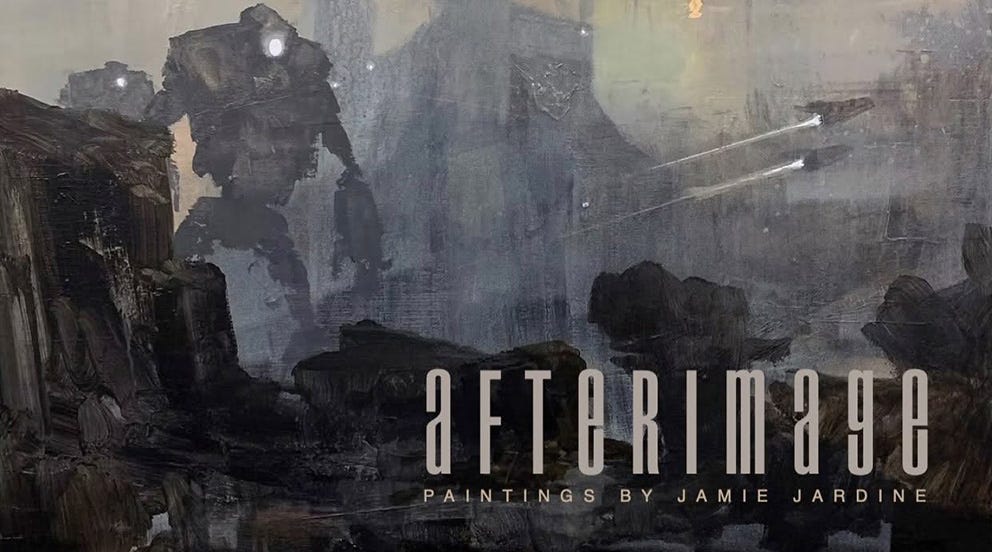
Arts-wise, there is The Elgin Theatre Guild (which I’ve been to a number of times now), and the St. Thomas Elgin Public Gallery. The Gallery and the current show by artist Jamie Jardine is our spotlight for this week, so join me on this trip to the Railway City, as well as to nearby Port Stanley (always a fave)!
The Loon Recommends for July 30 - August 2, 2026
Afterimage - Jamie Jardine Gallery Gallery Show in St. Thomas
Meet the People Behind the Events - An Interview with Jamie Jardine
Afterimage - From Landscapes to Giant Robots
July 11 - August 22 | St. Thomas–Elgin Public Art Centre | FREE
I first came across Jamie Jardine’s work about 15 years ago, when he was exhibiting work at some local London galleries. His painterly style struck me and I became a fan of his work. Jardine has spent almost three decades painting primarily landscapes and abstract work (often collaborating with fellow local artist Jane Roy).
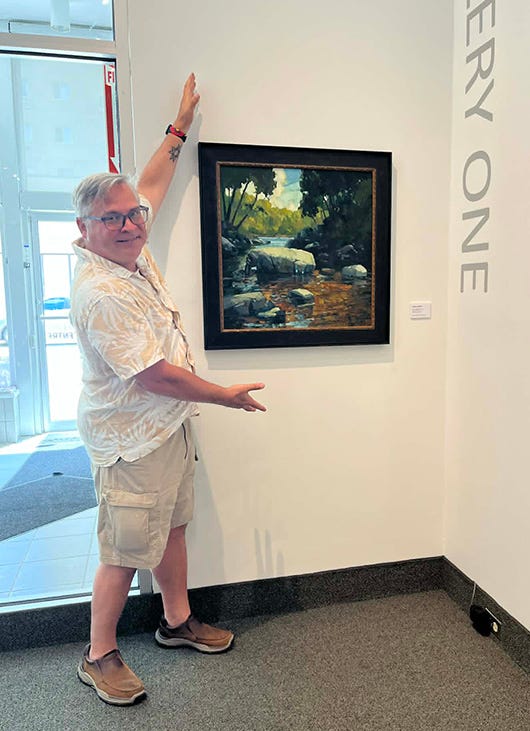
He still paints landscapes and abstract work and I still love it, but in recent years he started to paint from his childhood loves and obsessions—from haunting industrial scenes to giant robots, classic monsters and science fiction imagery. The result is his current show “Afterimage” a fascinating exhibition that’s as much about imagination and memory as it is about place.
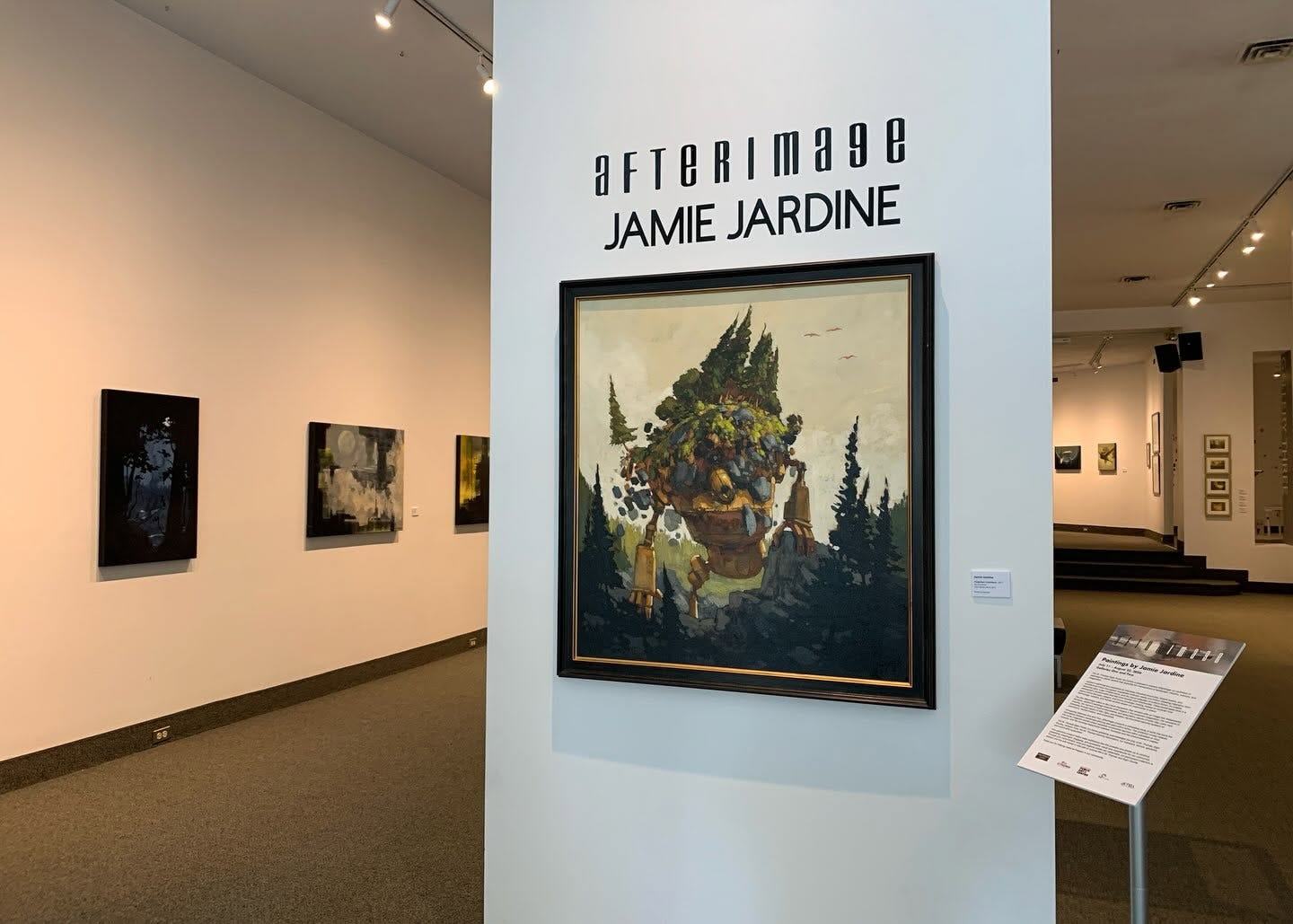
Afterimage is now on view at the St. Thomas–Elgin Public Art Centre, featuring new paintings that explore memory, place, and the traces left behind by human presence. Through atmospheric landscapes and evocative industrial forms, Jardine’s work exists somewhere between reality and imagination, inviting viewers to reflect on what lingers long after a moment has passed—and what remains embedded in the landscapes we call home.
My husband and I made the trip to St. Thomas to see the show and it’s a lot of fun. It’s a really nice size with a very welcoming staff. I’ll be back for sure. We made a afternoon of it, and went to Port Stanley for drinks afterwards and a late lunch.
We hit up Riva, a wonderful Italian restaurant with lakeside views, and Port Stanley Brewing Company (which is right beside it). I’ve become a fan of their Port Stanley Dunkel beer, which they describe as “Deep amber-brown lager with toasted malt flavours and notes of chocolate and caramel”. There a few places in London that serve it, including The Church Key, Milos’ and The Bungalow. I recommend it!
Sponsor Highlight: Downtown London
The Downtown London Patio Trail is back for another season! ☀️🍹
ADVERTISEMENT

Check in at participating patios on the Downtown London Patio Trail to earn points toward Downtown Dollar Gift Cards, exclusive discounts, and other prizes. With 30+ patios to explore, there’s never been a better excuse to get outside!
Forest City Arts & Culture Round-Up is sponsored by Downtown London
https://www.downtownlondon.ca/trails
Supporting independent local journalism in our community
Five Questions with Jamie Jardine
Jamie Jardine talks robots, memory, process and the evolution of his latest exhibition, Afterimage.
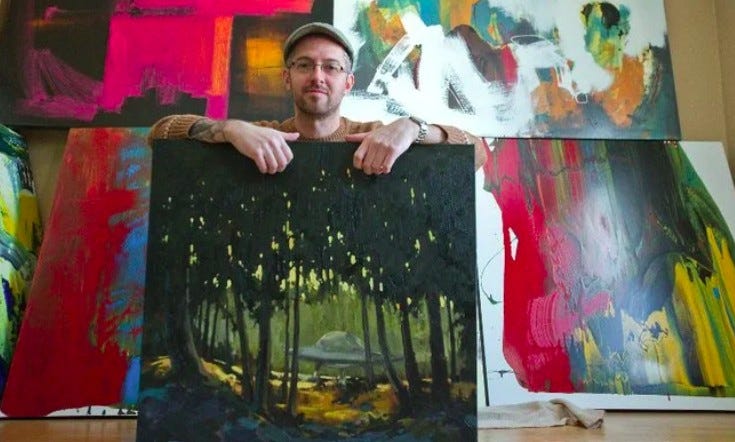
1. I think of you as being a primarily landscape and abstract artist, but you’ve been moving from representational landscapes and abstraction to science fiction over the last number of years.
I think you started off by buying canvasses from second-hand stores and then painting things overtop of them? Can you explain the process of how you came up with the concept behind your current body of work on display?
Yes, I have primarily been a landscape and abstract artist for almost 28 years now. I began to include Sci-Fi themes into my work around 2014, when I parted ways with my first gallery. I grew up with Star Wars (it was the first movie I ever saw and it had a huge impact on my 6-year old brain) and Star Trek, G.I.Joe, Transformers and He-man. As the youngest of 5 kids, I was often left to my own devices (i.e. my imagination for your younger readers haha) and spent all my time drawing, building lego or watching TV. All these things came flooding back once I left the gallery.
I didn’t actually start off buying thrift store paintings... in fact, I’ve never bought a thrift store painting. When I left the gallery, I had several unsuccessful landscape paintings in my inventory and I started with those. I had only ever seen one other person do this and that was an American artist by the name of Wayne White.
He would take old landscapes and put brightly coloured text across them. The response to my “Mods” was mixed but the side that approved was very favourable. On the other hand, this was the first time I had dealt with negative feedback... and I kind of liked it. Very different from the “safe” space that landscapes held. So I dove in and started adding large Robots to these landscapes and a whole avenue opened up.
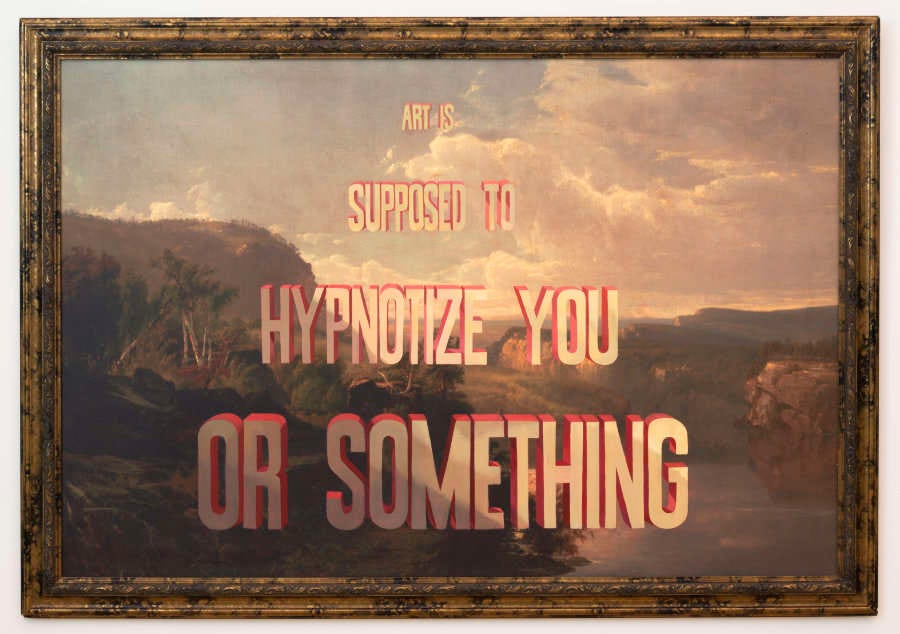
Editor’s note: I LOVE Wayne White’s work and especially these pieces Jamie describes. I saw a show of his in NYC years ago where these were on display, and are reminiscent to me of some of Greg Curnoe’s work. White was one of the original designers on the Pee-Wee Herman TV show and is married to cartoonist Mimi Pond.
And Jamie says that people did start giving him thrift store paintings to work with. Sometimes they were really old and in many cases, fairly damaged, so working with them made him feel that he was “breathing new life into them”. He had done about 7 thrift store “mods” as he calls them to-date.
My most recent body of work still feels like a work in progress. After 28 years of painting in the gallery system (and living off your work), it has become very difficult to sort through my own thoughts and motivations. I know what I like but I don’t always know how to put it down on canvas. The real motivation was a decision to just do it... try not to think too much... try not to worry if it’ll sell... paint what you want to paint.
The current exhibition has both new and some older pieces. The older ones represent moments in between landscapes when I needed to try something else but didn’t quite have the confidence to commit to it.
2. Do you see your landscapes, abstract work, robots and sci-fi imagery as separate bodies of work, or are they all connected by a common thread?
Well I suppose the common thread is me. Early in my career I was encouraged to “pick one and stick to it” but that just wasn’t the way I worked. I admired artists who had stuck to one genre or theme because I always felt I’d lose traction when I switched... and I switched often... like every 2-3 weeks.
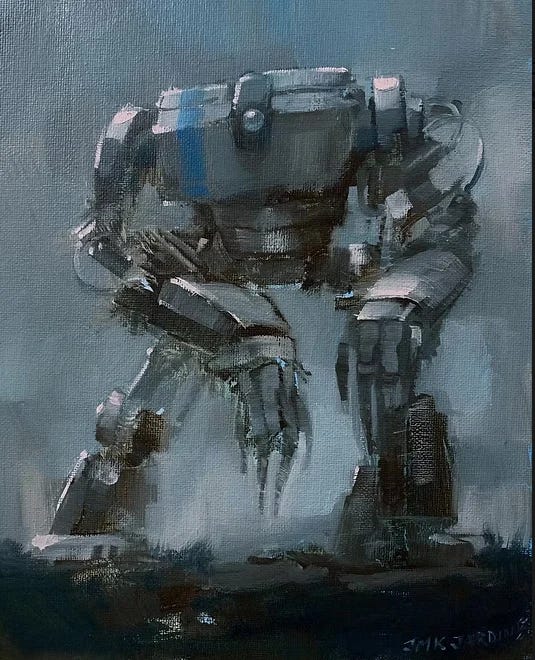
Over time I began to embrace that these were “Me” and I stopped trying to make excuses for the erratic behaviour. I think similarities between the work have always been there, I just couldn’t see them. Just before my current exhibition I had a studio visit from Laura Woermke and she saw the connections. The paint application or the colour palette definitely crossed over and it was eye-opening to see an abstract next to a sci-fi piece. They went together and things started to seem a little clearer.
Editor’s note: Laura Woermke is the Executive Director of the St. Thomas -Elgin Public Art Centre, and an accomplished artist in her own right.
3. One of the really touching things in your show in St. Thomas is the framed hand-written letter to you from Merle “Ting” Tingley” that must have been in response to something you sent him. What did you send Ting, and why did you include the letter in the show? What does the letter mean to you?
I was in grade 3 when the London Free Press came to my classroom and put on a presentation. Part of that (and likely a good way to connect with the kids) was to talk about one of their political cartoonists, Ting.
I was hooked. I went straight home and started to go through the stack of old newspapers. I found him! I found the Luke worm! This was around the time I realised one could have a job doing this. I sent him a small drawing of a cat wearing a smoking jacket and holding a martini... I wish I could remember why I did that but I still remember the drawing.
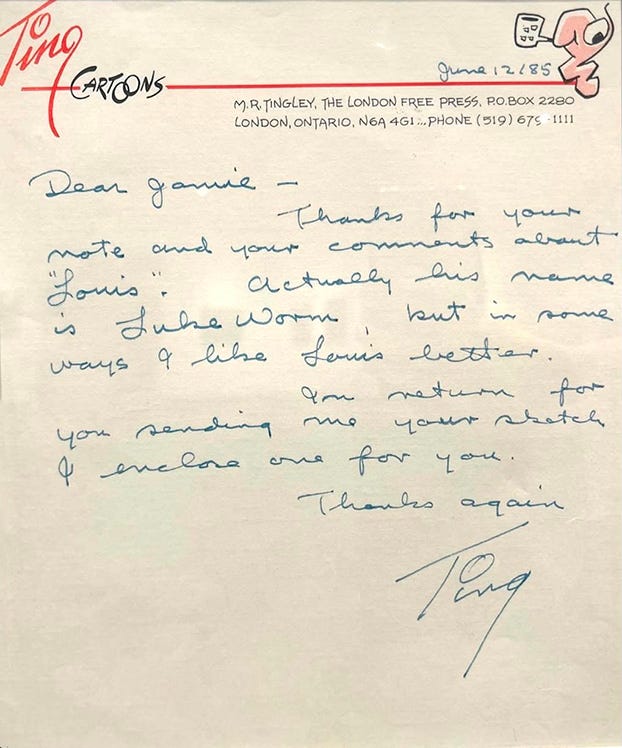
Dear Jamie,
Thanks for your note and your comments about “Louis”. Actually his name is “Luke Worm”, but in some ways I like Louis better.
In return for you sending me your sketch I enclose one for you.
Thanks again, Ting
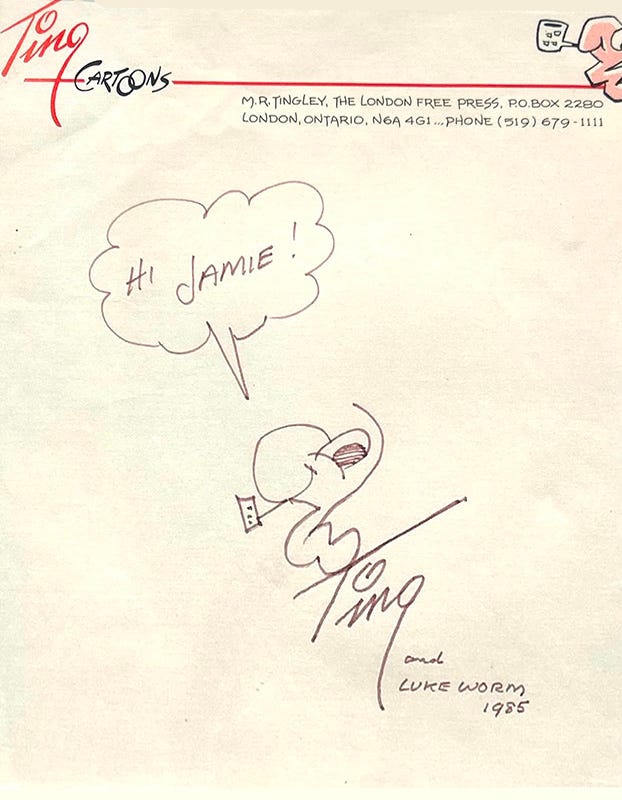
I wouldn’t meet Merle Tingley for another 40 years but he was the driving force behind my decision to become a Cartoonist (and I thank you for that Diana). Clearly my trajectory shifted a little but I will always credit him with giving me the drive to make art for a living.
Editor’s Note: I'm the founder of the Ting Comic and Graphic Arts Festival, an annual festival celebrating comic and graphic artists from Southwestern Ontario. It was named after Ting, the editorial cartoonist for the London Free Press, who was a huge inspiration to many of us. Ting used to hide “Luke Worm” into each of his editorial cartoons.
Jamie was a featured artist of Tingfest in 2015. In 2014, the inaugural year, Merle Tingley attended the festival and was treated like a rock star. People came from far and near to see him (including Jamie). It was a super heartwarming evening and something I’m really proud of.
4. I’ve read that you’ve said that your recent work is driven more by process and materials than by traditional approaches to painting. What happens in the studio when you allow the process to lead?
I’ve never claimed to be a traditional artist and certainly don’t use traditional techniques. There’s been a lot of “trial and error” over the past 28 years. But like most artists at this stage of their career, we’ve put in our 10,000 hours and there’s a good chance we are really good at something.
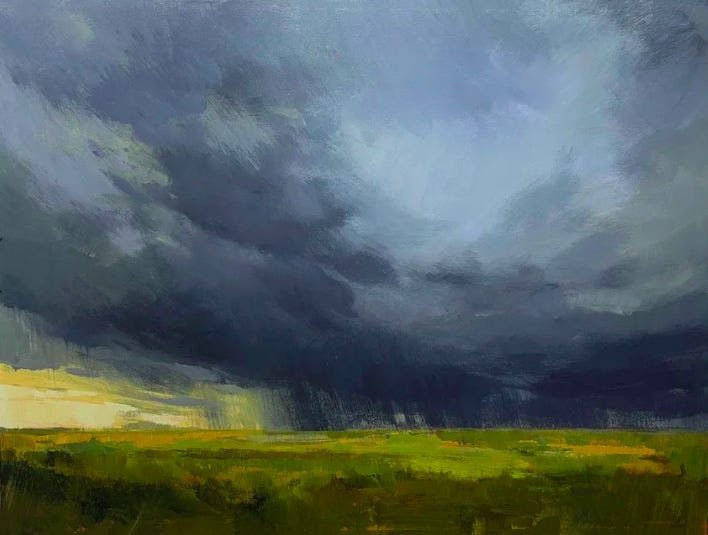
I’ve always enjoyed pushing paint around. That was likely one of the factors for including abstraction into my repertoire. I don’t think there’s a single painting of mine out there that I did much planning for. Most pieces usually start off by slapping some paint to a white canvas. My best works are the ones that speak to me..., and no, I’m not hearing voices but patience and time can allow you to see many different things before you start refining the work. In some cases, a robot or spaceship comes in right at the end of the painting to make sense of the work around it.
You’ve been making art professionally for more than 25 years, and this new exhibition marks another chapter in that journey. Looking back, what has changed most about the way you think about success, not just as an artist, but as a creative person?
Great question. Early in my career it was about sales and survival. With that, came many wonderful relationships and I have met so many people who have supported me in so many different ways. I will always be very grateful for that.
I’m not sure choosing to live off my art was the smartest decision though. I’ve been at this for 28 years and there have been highs and lows. I’m not sure if the struggles were worth it... especially once children entered the equation but it’s all brought me to where I am now.
Now I believe success to an artist is just doing it.
It takes a certain kind of person to give up all those “normal” things in life in order to pursue something inside that is hard to explain to others. Success over the years wasn’t always having an idea, putting it into practice and seeing it through, it needed to be followed by a financial gain... then I was successful.
Looking back I, now, know that everything leading up to the financial part was a success. Today success is the ability to follow what really interests me and follow through with it.
Although the gallery system seems to be in a bit of a limbo these days, I’m also very grateful to have a good gallery who stands behind me and my work. For me, having that kind of gallery is a success on its own. Entering the gallery system is a choice and finding a great gallery, a great framer and great supporters is rare. I feel fortunate to have found them all.
The Loon (London Ontario Online News) lineup
New content every day!
We’ve teamed up to send you a new feature every weekday:
Monday - Buckle Up - podcast with Matt Brown - SPONSORED BY HAMILTON ROAD BIA
Tuesday - Ward Tours with Cedric Richards - SPONSORED BY LONDON BICYCLE CAFÉ
Wednesday - City Hall Notes by Mike Donachie - SPONSORED BY SPERO LAW
Thursday - the Forest City Arts and Culture Roundup by Diana Tamblyn - SPONSORED BY DOWNTOWN LONDON
Friday - Reflecting, with Steve Cordes - SPONSORED BY OLD EAST VILLAGE BIA
And free on Fridays: the ROUNDUP, briefing you on the stories you need to know, gathered in one place. Regular analysis of the issues affecting London and the region.
That correspondence between Jamie and Ting is precious. It shows what effect just a little care and attention can have on an aspiring artist.
Wonderful article - accessible, engaging and educational! Thanks!