


November 20, 2026

Introducing Tomorrow’s Take Today
For more than 40 years, my career has focused on creating opportunities for young people to engage in their communities, access support and have their voices heard, particularly those who have traditionally been marginalized or excluded.
When we launched The Loon, our goal was to create an online news service that benefits the community. The first six months have been an incredible journey, and now we’re looking for new ways to build on the foundation we’ve created.
For me, that means making more room for young voices.
That’s why I’m excited to introduce Tomorrow’s Take, Today, a new monthly feature from The Loon that gives youth and young adults in London and the surrounding area a platform to share their opinions, ideas and perspectives.
Each column will be written by a young person with something to say about an issue that matters to them. Topics will vary, but the goal remains the same: to encourage young people to participate in conversations about their community and its future.
After all, if we want young people to become engaged citizens and community leaders, we need to do more than invite them to participate. We need to listen to what they have to say and integrate their perspectives into how our community is shaped.
This is the first of what we hope will become a regular monthly feature. Know a young person with a perspective worth sharing? Encourage them to reach out through the comments or contact me through The Loon at:
londonontarioonlinenews@gmail.com
Steve Cordes
Opinion Editor, The Loon
Beyond The Ballot: What London’s Mayoral Election Reveals About Democracy
By Anusha Das
Elections are opportunities for citizens to hold political leaders accountable, particularly when dissatisfaction with government is growing. Yet London’s 2026 mayoral election challenges this assumption.
Despite public concerns about homelessness, traffic congestion, development, and the condition of downtown London, incumbent Mayor Josh Morgan secured reelection with approximately 45% of the vote. This raises an important question for me: why does frustration with municipal conditions not necessarily translate into political change?
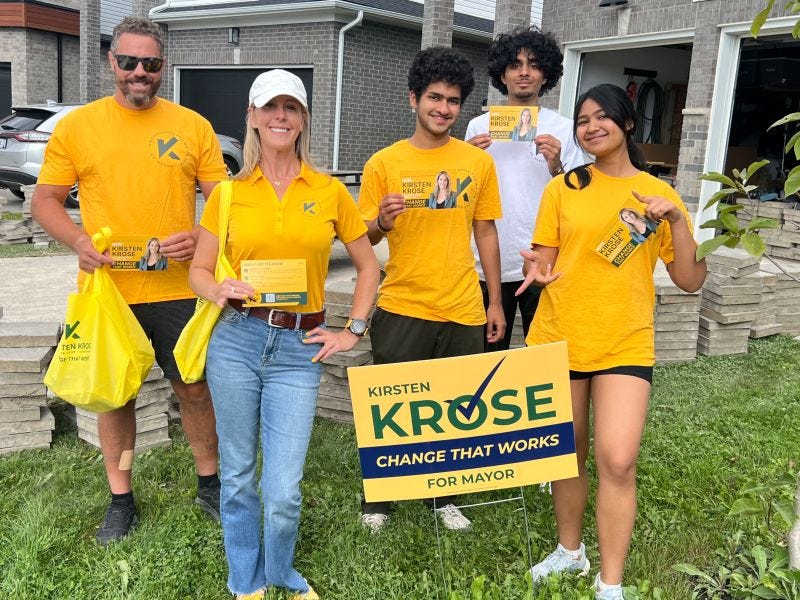
As a university student, I had the opportunity to experience this election beyond the classroom. I served as Co-Campaign Manager for Kirsten Krose’s mayoral campaign, gaining firsthand political experience and a grassroots understanding of the issues affecting Londoners.
Through door knocking, community outreach, and engagement with stakeholders across the city, I encountered residents with different priorities, expectations, and perspectives on municipal leadership. These interactions revealed an important distinction between public dissatisfaction and electoral behaviour. Understanding an election requires looking beyond the final vote count to examine the concerns, considerations, and choices that shape it.
The City of London’s 2025 Resident Satisfaction Survey reinforced many of the concerns I heard directly from Londoners throughout the campaign.
The survey found that 57% of respondents identified homelessness as the city’s most pressing issue, while 23% cited traffic congestion and 22% identified mental health and addiction concerns. Yet the same survey found that 82% were satisfied with city services.
These findings show that residents can be concerned about particular challenges while still recognizing aspects of municipal government that are working well. They also highlight an important contrast between wanting improvements in a city and wanting a change in its political leadership.
This distinction was evident in conversations about the mayoral race. While canvassing, I encountered residents who expressed concerns about the direction of the city but remained hesitant about replacing the incumbent. Their responses highlighted the influence of incumbency advantage. Morgan entered the election with four years of mayoral experience, established public visibility, and familiarity among voters.
Challengers faced the task of building recognition and convincing residents that alternative leadership would better address their concerns. For some voters, experience and familiarity may have provided reassurance, while others may have genuinely approved of Morgan’s performance. The result illustrates how an incumbent can retain support even when voters believe there is room for improvement.
The choices facing voters were further complicated by the possibility of strategic voting. My conversations with Londoners were not always centred on which candidate they preferred; some were equally concerned about which electoral outcome they wanted to avoid.
This became particularly relevant as Susan Stevenson emerged as one of Morgan’s closest challengers. In his analysis for the London Free Press, Jack Moulton highlighted an expert’s observation that voting against Stevenson effectively meant voting for Morgan.
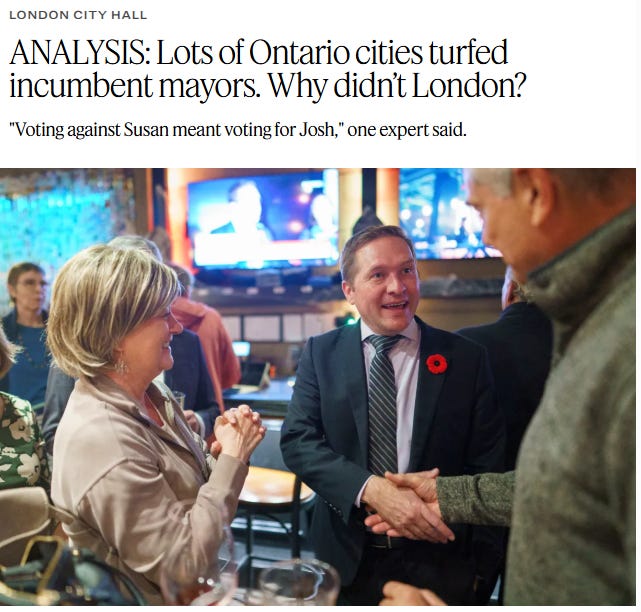
Mike Donachie, writing for The Loon, similarly interpreted the result as a rejection of Stevenson’s approach to political change. Although these interpretations cannot establish the motivations of the entire electorate, they suggest that some voters may have prioritized preventing an undesirable outcome over supporting their preferred candidate. In a system where the candidate with the most votes wins, such considerations can have a significant influence on the result.
However, the most striking figure for me from the election was not the winning candidate’s vote share, but the number of Londoners who did not vote at all.
Turnout reached approximately 31%, an improvement from roughly 25% in 2022. Nevertheless, nearly seven in ten eligible voters did not participate. Morgan’s 45% share of votes cast therefore represented support from approximately 14% of the eligible electorate.
This does not undermine the legitimacy of his victory, nor does it suggest that non-voters opposed him. It does, however, demonstrate the limits of interpreting an election result as a measure of public confidence. The preferences of nearly 70% of eligible Londoners remain unknown.
Participation also varied across the city. Writing for The Loon, Cedric Richards observed that western neighbourhoods recorded higher turnout than communities in east and central London, identifying broader inequalities involving income, education, housing, and political engagement as relevant considerations.
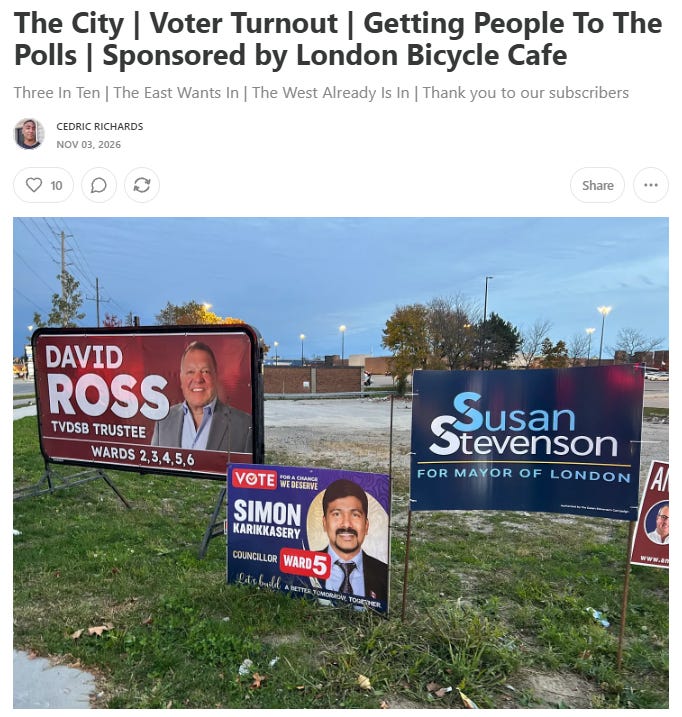
These differences matter because municipal decisions affect neighbourhoods in different ways. When some communities participate more consistently than others, their priorities may carry greater weight in electoral outcomes. The question is not simply how many Londoners voted, but whether participation reflects the range of communities and interests that make up the city.
Low turnout also reveals a difficult reality about political dissatisfaction. Public frustration can motivate demands for change, but it can also discourage participation when residents believe their vote will make little difference. Regardless of whether citizens participate, political decisions will continue to shape their communities.
Voting remains one of the most direct ways to influence political leadership and hold elected officials accountable. This highlights the importance of encouraging greater civic participation, especially among the next generation of Londoners, whose involvement will help shape the city’s future.
Decisions made at City Hall influence housing affordability, public transit, infrastructure, development, and the services that shape everyday life. Serving as a municipal campaign manager gave me the opportunity to engage directly with these issues and the people affected by them.
Staying informed about municipal issues, evaluating candidates, and exercising the right to vote are important ways for citizens to influence their community’s future. Greater participation would allow more Londoners to have a say in the decisions that affect them, rather than leaving those decisions to a relatively small portion of the electorate.
Looking beyond the ballot, London’s 2026 mayoral election reveals that political dissatisfaction does not always translate into electoral change. Reflecting on the election, I came to understand that expressing frustration, choosing a candidate, and proceeding to cast a voting are three distinct political behaviours.
We often think of political power as something held by elected officials. Yet the highest public office in a democracy is arguably that of the citizen.
Elected representatives exercise authority, but citizens decide who receives it. Ultimately leaving us with an important question: when nearly seven in ten eligible citizens remain absent from the ballot box, how fully can an election reflect the voice of the community it represents?
About the Author

Anusha Das is a fourth-year student at Huron University College, pursuing a double major in Economics and Governance, Leadership and Ethics. She served as Co-Campaign Manager for Kirsten Krose’s 2026 London mayoral campaign, helping lead a citywide effort focused on community engagement and political participation.
A former President of Huron’s Political Science Association, she has a strong interest in politics, public service, and civic engagement. She believes that the young adults have an important role to play in shaping their communities and hopes to encourage more youth to recognize the value of their voices.
The Loon (London Ontario Online News) lineup
New content every day.

We’ve teamed up to send you a new feature every weekday:
Monday - Buckle Up - podcast with Matt Brown
SPONSORED BY HAMILTON ROAD BIATuesday - Ward Tours with Cedric Richards
SPONSORED BY LONDON BICYCLE CAFÉWednesday - City Hall Notes by Mike Donachie
SPONSORED BY SPERO LAWThursday - the Forest City Arts and Culture Roundup by Diana Tamblyn
SPONSORED BY DOWNTOWN LONDONFriday - The local news ROUNDUP
Sunday - Steve’s Reflections
SPONSORED BY OLD EAST VILLAGE BIA
Also on one Friday each month: Tomorrow’s Take, Today: A New Generation Speaks
Every other Saturday: The Matt Brown Podcast. It’s the show about all things local, and maybe some other stuff too. SPONSORSHIP OPPORTUNITY AVAILABLE.
Excellent analysis and presentation on London, Ontario Mayoral Election 2026