


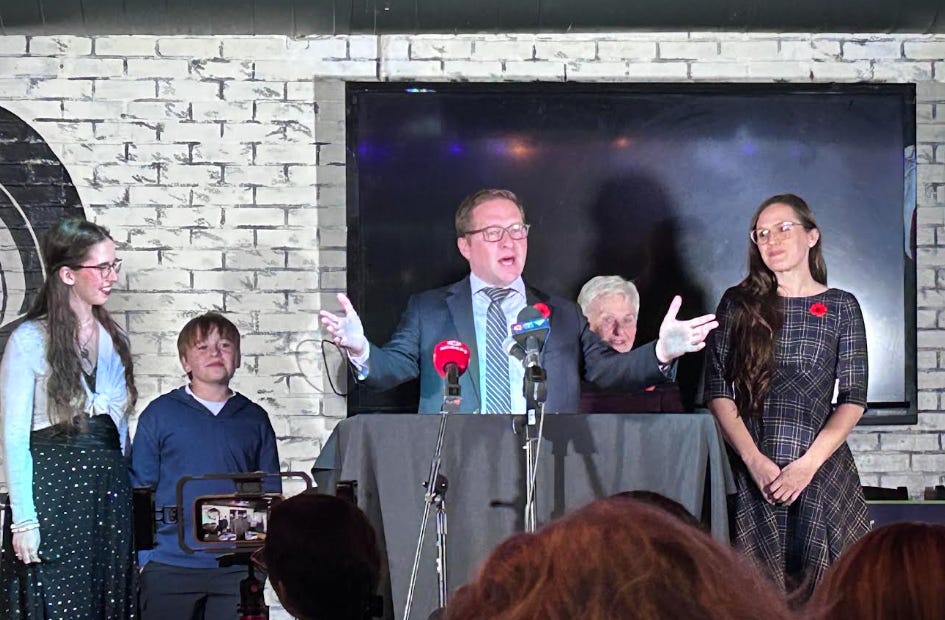
In the end, it ended not with a bang but with a whimper... and life goes on.
When Election Day arrived and all the shouting was done, up stepped an electorate that quietly knew what it wanted.
And it wasn’t Susan Stevenson.
Don’t get me wrong: she was a huge influence on this election, and on the change that’s in the air. Notably, we can expect action on a flurry of late election promises such as late-night construction. But it’s not the change that some had feared; it’s gentler, more measured. City business continues and its leadership, strategies and plans will be much the same.
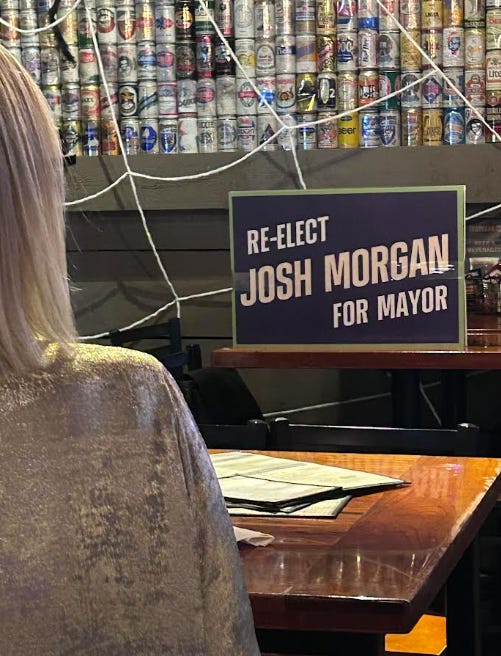
We all know the election outcome by now, but here’s the gist. Incumbent Josh Morgan was re-elected by a wide margin from his main challenger, Ward 4 councillor Susan Stevenson. Some down-ballot mayoral candidates polled respectable numbers but didn’t threaten the outcome. This came as much of the rest of the province was replacing its municipal leaders – there are new mayors in Brantford, Cambridge, Hamilton, Kingston, Sarnia… oh my, it’s a list… Waterloo, Welland and Windsor, and also Mississauga, Niagara Falls, North Bay and Timmins – and can be seen as a resounding endorsement for Mayor Morgan. It’s a pivotal moment in his political career.
As for the rest of London City Council, almost all incumbent councillors kept their seats and we have four new members who appear to have a good understanding of City business. So that means a level of continuity, even as everyone has listened to – and accepted – voters’ desire to see London’s challenges met head-on. The electorate has made a clear decision about who they trust to lead them, and those people have power now.
It’s time to get to work.
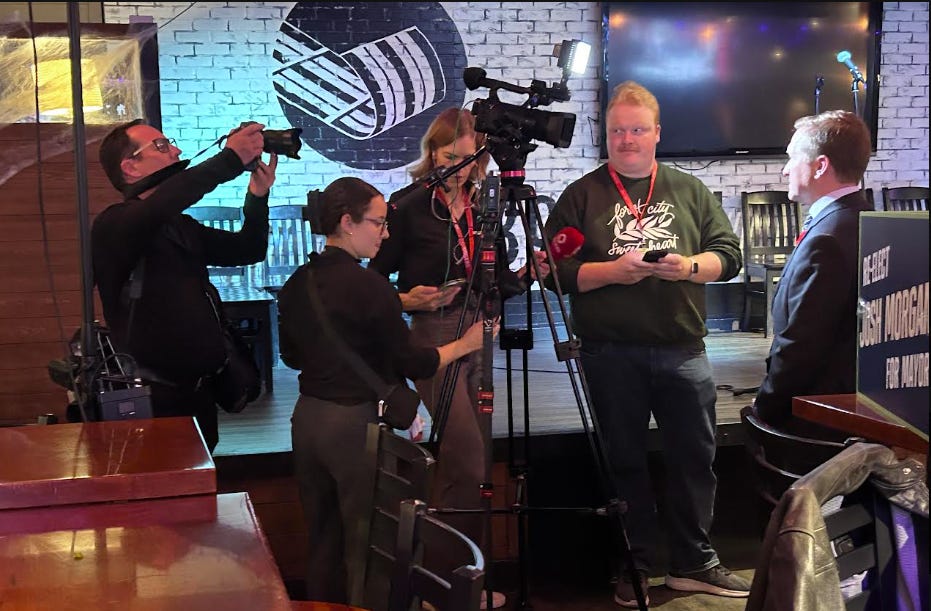
Wait, what is this?
It’s City Hall Notes, the blandly-named Wednesday column here at The Loon, all about local government.
Hi, I’m Mike. I work in Communications and Public Relations and, as many readers know, I’ve spent the last 10 months paying close attention to municipal business and the election that has overshadowed it. This week, I’ve been privileged to be in the room with many of those involved, and heard many opinions, reasoned and otherwise.
Here are my clickbaity seven thoughts about it all. Thanks for reading.
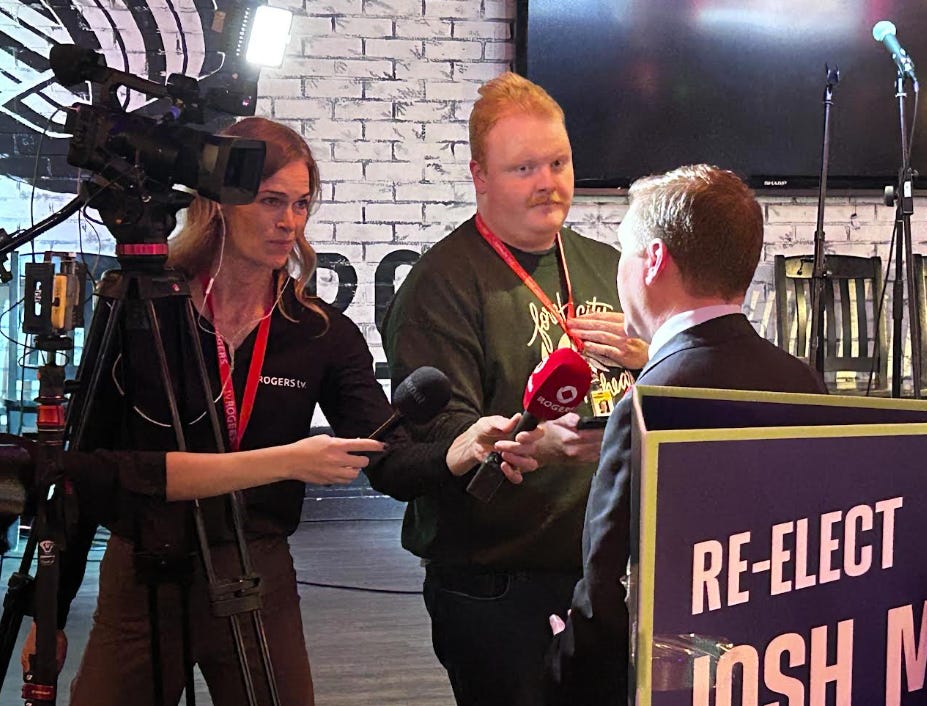
1. Stevenson wasn’t even close
All through the campaign, I was convinced that Susan Stevenson had the noise but not the numbers. And, the closer we came to election day, that noisy strategy – with lots of social media, generalized statements about services, challenging comments and so on – commanded the headlines; sometimes it looked like it might be working. Against a history of low voter turnout, was she creating or converting the votes she needed to challenge Morgan?
Well, no. She was not. We know that now.
With 103,163 people exercising their franchise, Josh Morgan polled 46,405 votes – almost exactly the same number as four years ago. In fact, he totalled only 122 more votes than the 46,283 he had in 2022. This number is astonishing in its consistency, even if we did have 50,000 more potential voters this time. He’s the first mayor to be re-elected in 20 years, and the result is a Xerox. That, right there, is a mandate.
(I said this on Devon Peacock’s radio show yesterday and messed up the math. I feel bad for the notional people who briefly existed and then vanished. I hope they’re OK.)
The unconfirmed results showed Morgan’s share as 45.42%, down from the 65% four years ago when his challenger, Khalil Ramal, was perhaps less effective. So, though it’s a strong victory, Morgan did lose some vote in percentage terms – just not in a way to make a difference.
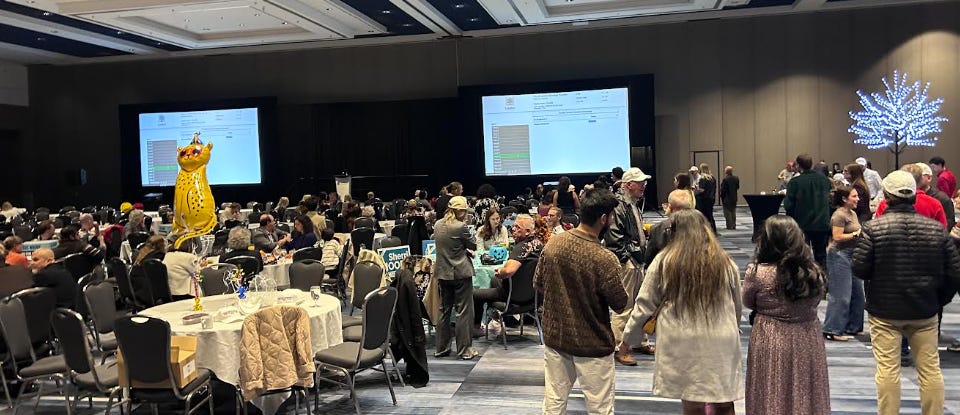
As a challenger, Stevenson was not the shatterer-of-worlds she may have appeared. Her 27,259 votes represent less than 27% of the total. That’s lower than, for example, Paul Cheng managed in total votes (38k) and vote share (34%) in the 2014 election, but better than Ramal in 2022 (16k and 23%).
Otherwise, we have respectable showings in 2026 from Kirsten Krose (10.75%) and Bronagh Morgan (7.25%). Even if we add Stevenson, Krose and Morgan B.’s totals, Morgan J. still wins a first-past-the-post vote. It’s only when we get to the fifth candidate, Tariq Khan (4,090; 4%), that the numbers stop working.
That’s a remarkable achievement for Morgan, who’s been put through the wringer for months as he has sought re-election. All those mayoral candidate debates, all the arguments in council, all the holding-to-account that happens to politicians… led us here.
Despite all the noise, the quieter candidate won.
By the way, don’t go believing people’s patter this week. There was real disquiet at City Hall that Stevenson might win – feelings of job security were at an all-time low, thanks to all her promises of rapid and impactful change. Nobody laughed at my references to the Fall of Saigon.
Now we have the results, everyone is saying, “Oh, I knew it would go this way,” but on Monday they were singing a different tune. There’s a lot of relief in the local municipal sector right now.
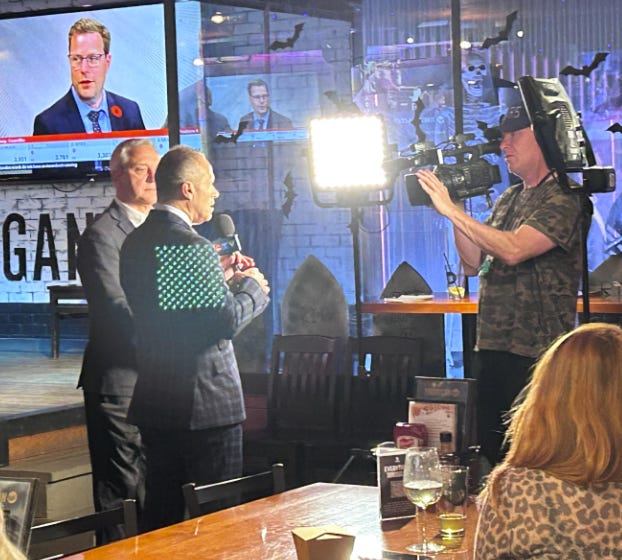
2. This looks like a progressive council
Now let’s look at the council we just chose. The factors in the 15 races for London City Council members are complex, of course, and we can spot themes in the campaigns.
In particular, many incumbents found themselves facing challengers who were fiercely critical, often using similar approaches or messages to Susan Stevenson: it cost too much for bus shelters, or bike lanes, or BRT, or homeless shelters, or whatever bête noire. The lightning rod issue of homelessness had challengers het up and making statements that were often upsetting, inaccurate or at least lacking important context. But throughout, in ward after ward and especially at the all-candidates meetings, we heard incumbents (and some well-informed new candidates) cut through the noise with actual answers about what London is doing to address its problems.
And it looks like the voters listened well, because the loud folks ain’t on council now.
As part of this outbreak of common sense, it’s my opinion that progressive, arguably left-wing thinkers won the argument in key wards. I’ll take care before I ascribe views to everyone too readily but, broadly speaking, we now have perhaps seven or eight councillors who might be in that area, plus three or four centrists who are socially progressive, suggesting common ground.
Contrasting with recent times – and especially the days of the Fontana 8 – there are apparently fewer conservative-with-a-small-c councillors such as Paul Van Meerbergen, who was re-elected in Ward 10 for an incredible sixth term. And, among the newbies are progressive voices in Tom Cull, who succeeds Stevenson in Ward 4, and Ward 3’s Ben Durham, the only new member of council who defeated an incumbent on Monday, sending Peter Cuddy packing. They also feel they have a mandate, and they’re bringing it to 300 Dufferin as soon as they can.
What does this mean for our city? Don’t ask me – I’m jaded. But I know this: whatever your political bent, it’s evident that all of council must work together at times, and alliances are formed for all kinds of reasons in politics. Here, natural alignments are visible already, in contrast to the last council, a group that couldn’t even agree when to take a bathroom break.
Having listened to these successful candidates during their campaigns, I’m hopeful we’ll hear fewer dogmatic arguments in the chamber and see a better focus on making an impact on Londoners and our quality of life.
Opinion alert: I think that should include strong support for our most vulnerable neighbours this winter – yes, the ones on the street.
And for God’s sake, let’s stop complaining about the damn bus shelters. Things cost money. You can stand outside in the rain if you like, but leave the rest of us alone.
Breathe…
Let’s move on.
ADVERTISEMENT

City Hall Notes is sponsored by Spero Law
www.sperolaw.ca
Supporting independent local journalism in our community
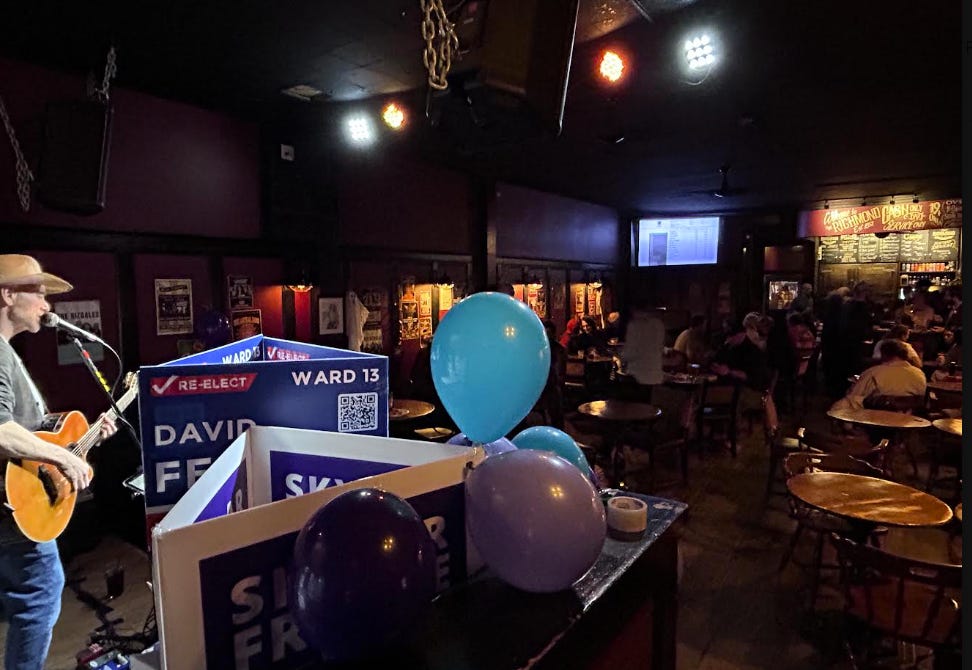
3. Ward 13 was the story of the night
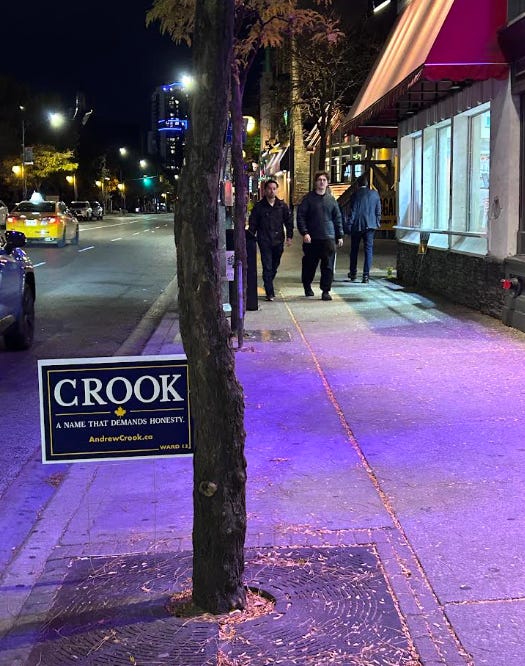
I keep calling Ward 13 a poisoned chalice because it’s hard to survive as the downtown councillor. Well, David Ferreira survived and thrived, turning the tiniest majority on council (just 34) into one of the most powerful seats, pulling in 4,308 votes – a massive 69% of the ward’s total. He’s the first council member the core has returned in a generation and it’s happened in a landslide. At the same time, he handily defeated one of the loudest and most visible challengers among the ward races: Andrew Crook, with widespread signs promoting his “name that demands honesty”, polled just 735 votes, a little under 12%.
Make no mistake: Ferreira won this by campaigning hard. That’s also a theme in this election, with many victors confirming that votes are won by showing up at front doors and winning people over. In downtown and its nearby neighbourhoods, this councillor and his extremely loyal team won the race by making a stronger argument. It’s inescapable that hard work and worn-out sneakers have been key to success in Election 2026’s ward races, at least.
4. Massive vote of confidence in incumbents
We may have spent recent months listening to people complain and hold councillors to account but, in the end, they voted almost all of them back into office with strong majorities. All the winners had to work for it – see those comments about sneakers, above – but this remains a remarkable story of incumbents just destroying their challengers.
In the end, Elizabeth Peloza (Ward 12) had the biggest per-cent share at 78, with Skylar Franke (Ward 11) on 75%, David Ferreira’s remarkable 69%, Steve Lehman (Ward 8) with 67% and Shawn Lewis, facing a stronger challenge than when he commanded 86% last time but still scoring 65% of the vote in Ward 2.
Even where were there multiple challengers, incumbents won the popular vote. In Ward 6, for example, Sam Trosow had what looked like a tough battle against Stephanie Marentette and Ian Sterling Leishman as he defended a majority of just 299. In the end, Trosow’s 2,466 votes (48%; majority of 1,019) were more than the next two combined.
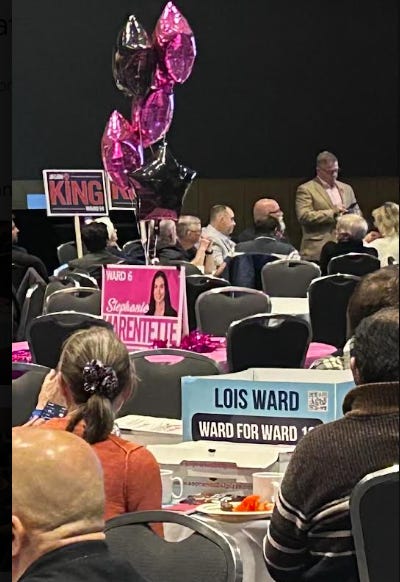
In Ward 10, Paul Van Meerbergen saw off all comers and starts his sixth term of office with 43% of the vote (3,498) – just a little more than the combined totals of the next two candidates, Lois Ward and Alex Moore. Neither of these wards was a “split vote” that gave a pass to sitting councillors. They’re both straight wins.
But, as mentioned, there was an unhappy outcome for single-term incumbent Peter Cuddy in Ward 3, where 208 votes separated him from victor Ben Durham, with 34% and 37% respectively. Cuddy is the night’s only exception.
5, 6, 7… The Lightning Round
That’s a lot to digest, and I am grateful for your indulgence if you have read this far. Finally, some quick hits that might interest you.
Turnout was up. Some of the numbers are interlaced above but it comes down to this: 31.01% of eligible voters cast their ballots, up from 25.5% in 2022. In numbers, that’s 103,163 voting this week, against 71,678 last time. The total number of eligible voters also increased, of course, from 281,073 to 332,688.
Council is very white. I can’t be sure how everyone identifies and I’m open to hearing from anyone whose ethnicity I may have misconstrued, but it looks like 14 of the 15 council members are white. The exception is Ward 5’s Corrine Rahman, the nearly-incumbent who was elected as expected (boundary changes put her home in Ward 5 instead of Ward 7).
Council gets its pay raise now. The councillors elected this week will be paid about $94,000 a year, a 35% increase on last term. All through this campaign, when facing critics, incumbents have been pointing out they did not vote themselves a pay raise, and instead the voters would have to decide if they would be paid the money in the next council term. I’d say that’s a done deal now. They’re all full-time and I understand some have been resigning from other jobs this week, to become councillors.
And some links
I’ll close with resources from the local media, who have this well-covered, as expected. For my part, I’m glad to provide an additional voice and, I hope, an accessible way to make sense of it all; I’m also very aware that there’s a great deal of content out there already. I hesitate to keep adding more and more and I’m seeking to be thoughtful about my contributions.
Here’s a roundup of the superb election coverage provided by local journalists.
Hard-working reporter Jack Moulton has led exemplary and comprehensive coverage in the London Free Press:
Three Josh Morgan campaign promises to watch (controlled tax hikes; special constables; and late-night construction)
And the big decisions facing city council (the budget, homelessness, development, and a new City Hall)
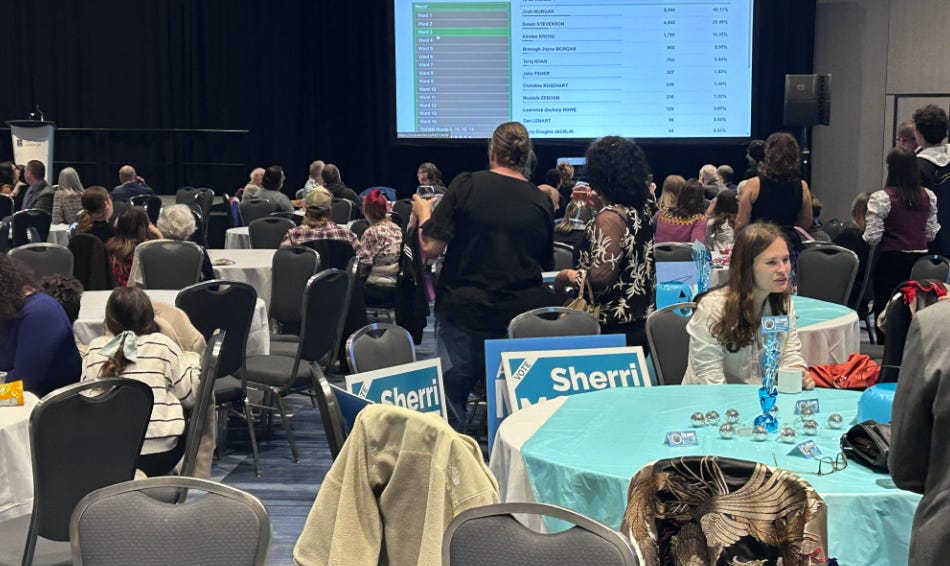
And don’t forget the trustee races. Here’s the Free Press’s Heather Rivers Davey interviewing re-elected trustee Sherri Moore. I’m sure we’ll hear more on the trustee elections as the dust settles.
More coverage? Oh, I suppose
CTV London’s Daryl Newcombe interviews the new councillors: LINK
And CTV sums up the whole election in a chunk of video here: LINK
Podcaster Craig Needles interviews councillors Shawn Lewis, Skylar Franke and Tom Cull: LINK
Here’s The Morning Show with Devon Peacock on AM980, with former police chief Murray Faulkner and departing councillor Jerry Pribil, who really did play for Celtic. (Also me, ugh, I should stick to writing.) LINK
Matt Brown and Steve Cordes were part of the panel for the Rogers tv coverage: LINK
And let’s not forget our public broadcaster. CBC London was actively reporting on our local election, even as its gigantic operation covered so many others.
Stats fans can revel in this outline of the election by the numbers: LINK
Here’s a news piece by Travis Dolynny, summing it all up: LINK
Andrew Lupton gives us five takeaways (including a victory that Ward 1’s Hadleigh McAlister richly deserves to celebrate): LINK
And Jack Sutton takes it wider, looking at elections around our region: LINK
I’ll leave it there, knowing I could be sharing everything to the GTA and beyond, and of course that’s already in everyone’s faces and is out-of-scope for a London City Hall column.
Enough
What a big week for London! After all the shouting was done, it turned out to be a traditional London election after all. Aside from a few scares (I’m still convinced infill housing was the reason Luke Thomas ran Anna Hopkins close in Ward 9), the leaders of our city rode out the storm, emerging with a stronger mandate and a more aligned council. This looks promising to me… though I’ll watch with care, having met politicians before.
And it’s been a big week for City Hall Notes. The municipal election has been the focus of this column since January, when it didn’t even really exist as a column yet, so I’m delighted to make it this far and, at your indulgence, perhaps make a small contribution to public discourse. Frankly, it’s been a mixed experience for me and I’m glad to reach this opportunity to stop and take stock. I’d be happy to hear folks’ opinions about City Hall Notes, especially any thoughts you have about what London needs and the service that could or should be provided. I’m staying open-minded on it.
Thanks again for following along, subscribing and otherwise supporting. It’s been great to connect with so many people and to learn together. What fun!
All the best
- Mike
The Loon (London Ontario Online News) lineup
Local independent journalism bringing you new content every day.
Find our editorial standards and policies here.

Meet the Londoners who team up to send you a new feature every weekday:
Monday - Buckle Up - podcast with Matt Brown
SPONSORED BY HAMILTON ROAD BIATuesday - City Tours with Cedric Richards
SPONSORED BY LONDON BICYCLE CAFÉWednesday - City Hall Notes by Mike Donachie
SPONSORED BY SPERO LAWThursday - the Forest City Arts and Culture Roundup by Diana Tamblyn
SPONSORED BY DOWNTOWN LONDONFriday - Reflections with Steve Cordes
SPONSORED BY OLD EAST VILLAGE BIA
Also on Fridays: the local news ROUNDUP.
Every other Saturday: The Matt Brown Podcast. It’s the show about all things local, and maybe some other stuff too. SPONSORSHIP OPPORTUNITY AVAILABLE.
I would love to know why 69% of eligible London voters don't bother to make their voices heard about how this city is run. Part of it, I believe, is not having a clear sense of what each of the Candidates actually stands for...or even recognizing their names. Our Mayor got 46% of the popular vote; in other words, fewer than 14% of eligible voters actively supported him. That's one reason the work you are doing with The Loon is so important. We need more aware and engaged voters to avoid a government that operates not for the people, but for specific interest groups, as our neighbours to the south have shown us.
Great piece, Mike. Thanks to everyone at The LOON for the high quality election reporting. I have a few thoughts.
The city, mostly, took a progressive turn. Wards 1, 3 and 4 in particular (although 1 was an incumbent). The unanswerable hypothetical is would Cull have defeated Stevenson had the latter not run for mayor? Their visions for the ward and the city were substantially different. I, for one, am hopeful for this mayor and council.
Did Bronagh Joyce Morgan take votes from Josh Morgan by being the first "Morgan" on the ballot? We will never know, but the Chow confusion in Toronto makes me wonder. I follow local politics a bit more than the average voter, but not to poli-geek levels, and had never heard of the other Morgan until I read the ballot.
As a Ward 9 resident, I watched that race closely. The outcome was as I expected: Hopkins winning, but not with a plurality, while the three right of centre candidates split the vote. I was surprised, however, at how much of that vote went to one candidate. This leads me to disagree with you that the defining issue was infill housing. My sign observations during frequent travels in the ward by foot, bike, and car showed me a definite urban-rural divide, with Thomas taking the rural areas and Lambeth while Hopkins took the suburban neighbourhoods. I am prepared to bet a coffee and a muffin on that, once we see the results by polling station. (Full disclosure: I hosted Coun Hopkins on a ride-along to discuss cycling infrastructure in the ward. The three others declined.)
One thought for the Cuddy and Caranci voices that were on with Craig Needles leading up to the election: a councillor shoveling a driveway, picking up a garbage bag, or taking away an abandoned construction sign might be good politics, especially at the local levels, but it is a sign of poor government.
Finally, apropos of nothing, any politician at any level who comes to my door, or sends me something, calling me a taxpayer loses my vote 10 times out of 10. I pay taxes, a lot of taxes, but that isn't what defines me as a citizen.
Thanks for hearing me out.