


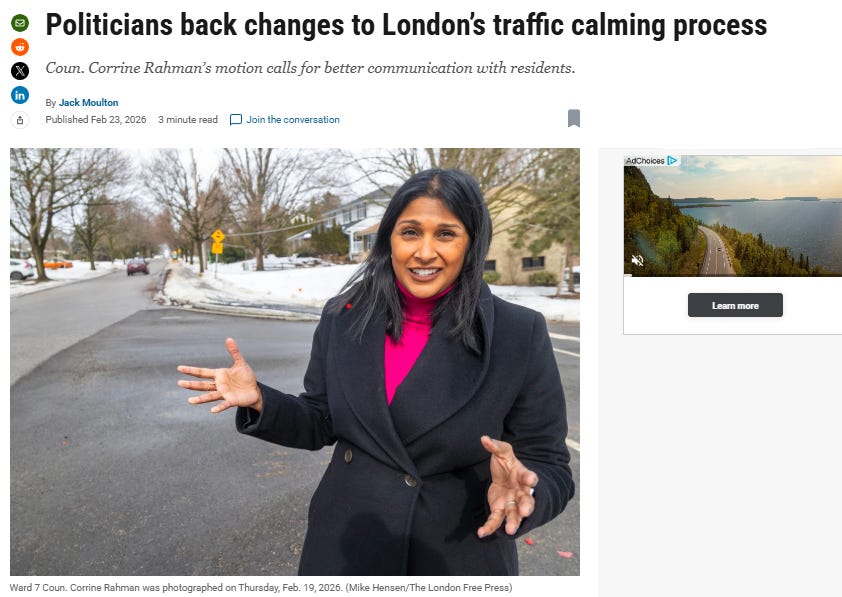
ENGAGING STANDARD NEUTRAL REPORTING VOICE.
This busy week at London City Hall hit an early highlight with a discussion about traffic calming.
Few issues are more triggering on a local level - this one is right up there with dog crap, garbage collection1 and the incredible way noise can travel across the city from Harris Park2. This post will be shorter than most, largely because it’s my stated policy to keep the heat out of my reporting, and also to distinguish reported fact from my opinion. In this post, that will prove a singular challenge.
First, the basics
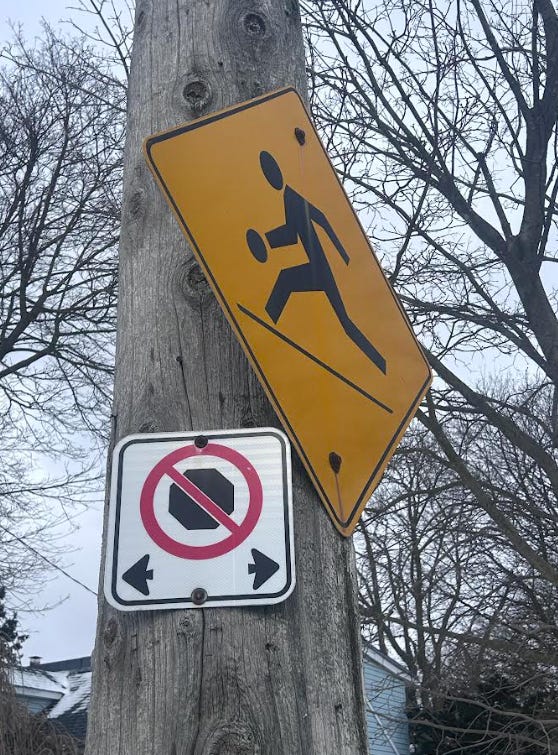
This was a conversation at the Infrastructure and Corporate Services Committee, which continues a long-standing and worldwide local government tradition of giving things names that no human could ever remember or type correctly at the first attempt. The news story itself is simple: Committee discusses traffic calming; requests staff report on better communication with public.
You can find the agenda here or, if you’re someone who prefers happiness, you can do most anything else that comes to mind. The main item is towards the bottom: 4.1 Traffic Calming etc. You’ll see that Councillor Rahman brought this to the committee, which also heard three delegations from the public.
The reporting is here:
London Free Press - as above, and focused on process. Reporter Jack Moulton finishes with this line, which I’ll address further down: City staff estimated a report on improvements to the traffic calming process could come back to politicians in the fall, following approval at the March 3 council meeting.
CTV London - Daryl Newcombe’s report has an astute heading referring to resources. Let’s remember this exchange took place:
“It is a small team. A lean team, and we try to work as effectively and efficiently as possible,” explained Doug Macrae, director of Transportation and Mobility. “That said, we’re hearing that it’s a priority for the city so we’re going to see how we can improve the service.”
“I think it goes without saying that if you need more resources, ask,” said Coun. Sam Trosow. “You will find a very sympathetic council.”
So, a popular item that everyone supports and will take on the campaign trail with them. And everybody’s happy.
Ah, but…
Let’s look at the practical outcomes from the meeting. I’ll do this in list form, to keep it as neutral as possible.
Facts:
It won’t lead to more traffic calming. This changes the existing application process, to keep residents informed in a better way. That’s welcome - and was unanimously welcomed - but I can’t see anything here that will speed it up, add more resources, or improve the process in any way that gets people what they want: traffic calming measures.
City staff can’t do any more. The meeting heard this is handled by a team of two, with one person on some kind of loan. Without additional resources, in that great pile of silos that forms Fortress Dufferin, this won’t lead to any tangible benefits.
It’s not in the budget. Note the City told the Freeps it spends $100,000 to $200,000 per year on this and receives 20 to 30 petitions. Remember this is the end of the current term, and this council had every opportunity to act before now. And this is quite a quote:
“We had this debate at the last multi-year budget, and it’s not something that’s gone away,” (Councillor Hadleigh) McAlister told CTV News after the meeting. “We’re definitely still hearing a lot of concerns about [speeding], and as the city grows, traffic’s part of that.”
I’m taking the fifth again, other than politely pointing out this is not a new issue. And there is still time to add funding, such as from Assessment Growth, so we shall see. But, without more money, this remains paper talk.
Any effect will likely be after the election. City staff indicated they will work on this in the fall. Yes, the fall. They’re too busy to bring back a report now so, even if it passes council on March 3 it won’t return until, at the earliest, the very last days of this council - which may be a Lame Duck by then.
The public see this this for what it is. All three (excellent) public speakers3 at the meeting were polite, honouring the social contract that bizarrely persists as the world burns. Welcoming the move to better communication, they talked of a city-wide problem mired in process, and the challenges that come from the initial road design.
Put more simply (my words, NOT theirs, and Opinion Alert): this is a sprawling city on a grid that’s retrofitting its roads, one-by-one, to make neighbourhoods more liveable. It’s a Band Aid on a gunshot wound. We should be building it properly instead, or addressing it well across the whole city, as a well-funded program to improve quality of life. This approach makes little difference.
So, why do this?
The answer is obvious in an election year, and I’m going to point out some aspects that may prove relevant soon:
Councillor Rahman has chosen a vote-winning issue that’s city-wide.
That meeting had some weird talk about unity on the issue, from a council that can’t even pass procedural motions with confidence. Hmmm. OK.
It’s all talk unless current members get re-elected or the people that beat them agree.
Look out for this one on flyers, and feel free to fact-check.
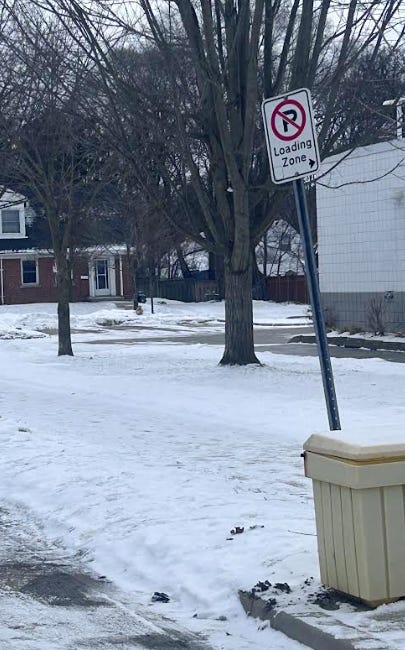
Finally, my risky opinion alert: the rest of the world behaves very differently from North America when it comes to car culture. If I keep typing I’ll get upset, or break my rules about winding people up, or say something problematic for a non-citizen. But, frankly, it’s tough to live here without saying things all the time.
The other day, I posted this in reply to a social media post by a former member of council:
Car culture is consistently presented as the norm in city business. It’s like some massive case of Stockholm syndrome. It’s slowly killing us all, it costs a ludicrous amount of money that nobody ever talks about, and we’re all miserable the moment we leave our driveways, if we’re lucky enough to have one.
It’s like a French farce, but less funny. And nobody does a thing.
Ooooh, this was a sharp one, wasn’t it? I hope your day improves4.
Quick edit: since I posted, I’ve had a great chat with one of the speakers, in which we agreed a lot. And I want to be really clear this is my opinion and no one else’s. There was a good spirit of cooperation in the meeting. And, I still cite their comments in support of my opinion. Thanks!