


There’s something in the air at City Hall, and it might, just might, be flying towards a fan.
Amid the usual business of overlong meetings, byzantine procedures and pointless disagreements, members of London City Council got together this week to help the homeless. Full credit for the outcome: instead of cutting services, as was proposed, members of a city committee increased them to help more people this winter. Well done! (It needs to be endorsed by Full Council on February 10, but well done.)
And, it was a moment. In this election year, with the clock ticking and only so many opportunities to make changes, all 15 council members know people are looking at them again. It’s been a long, confusing, difficult three-and-a-half years and now it’s time to pay the piper. Everybody knows it.
Let’s go through what happened.
People showed up to make a point
First, it’s winter, so of course that means an ‘emergency’ response to support the unhoused. But it’s an especially bad winter, so there’s been widespread concern about folks out on the streets.
And the relevant City Hall committee meeting – yesterday, Monday, January 26 – was the Community and Protective Services Committee, which for many years has been the starting point for councillors’ attempts to change services in one way or another.
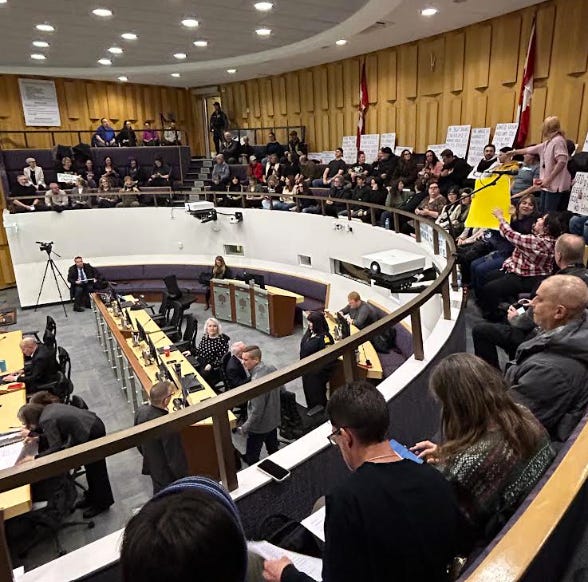
People had opinions. About 90 packed into the public gallery with colourful signs and a respectful attitude – lots of quiet tension, with people watching their council members expectantly. Several spoke to the meeting with real emotion about the need to support the unhoused. Some told stories, including one inspirational man who turned his life around after doing jail time for breaking into an empty property on a bitterly cold night. Some cried. And everybody listened closely. This was the electorate showing up to tell their councillors what to do. For most of them, it was an unusual feeling.
Three from the news agenda
The meeting involved a number of discussions. Here are three of them:
Councillors Sam Trosow and David Ferreira put forward a proposal to change the guidelines on when the City opens warming centres. This was in response to public concern, including about a particular night when it didn’t happen. Here’s a CTV report on that.
An attempt to enforce Good Neighbour Agreements on service providers, brought forward by City Staff. Supporters were concerned this would put onerous responsibilities on organizations that are already struggling with resources – as Steve Cordes summed up in his video blog, Community Matters, which he sent council members.
A motion by Councillors Susan Stevenson, Shawn Lewis, Jerry Pribl and Steve Lehman to end outreach funding and move it to other services. Here’s London Cares’ Chris Moss with the concerns on that one.
And there were more items. I’ve included some further notes here (scroll way, way down), but I’ll focus on those three.
Outcomes - London steps up
First, those warming centres and extra beds. That turned out well – here’s the London Free Press and CBC with full reporting. There was support for better services across all of council, and members worked together to agree on this. Lots of mutual congratulation took place.
On the Good Neighbour Agreements, representatives of service providers, including Chuck Lazenby from the Unity Project, spoke eloquently about this as a bad idea, unfair to the people who are already doing so much, and pleaded with councillors to consult people on the front lines of our housing crisis before making such a change.
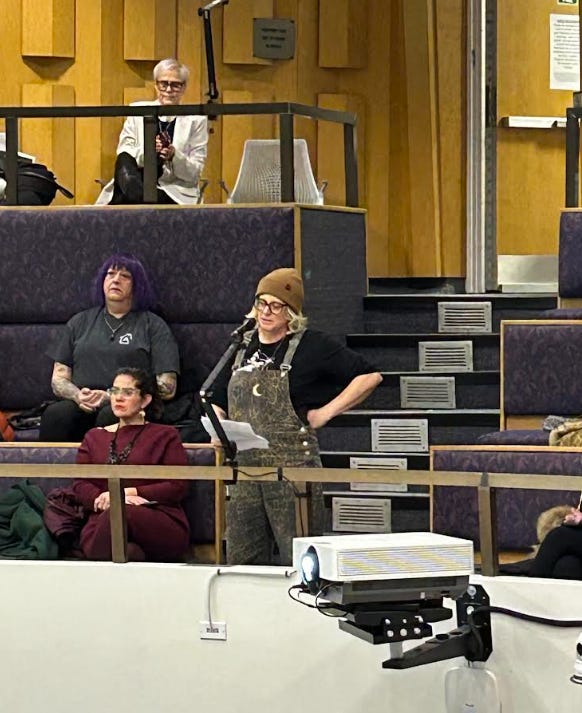
“This part of the framework demands a higher level of public accountability for service providers than is asked of elected officials, and without access to any comparable resources,” Lazenby said, per CTV.
And that outreach funding change? Also did not happen. At the end of the discussion, and after all the delegations, Councillor Lewis presented a compromise motion that retained status quo for a year, and called for consultations.
So, phew, that was good
The meeting took more than five hours, all in. I stuck around until just before 6, when I left to catch the comic book store.
It’s a lot of energy, right? Like some convoluted corporation, the council chamber didn’t seem to have much direction.
For a start, everybody clearly needed to pee. I heard at least two councillors talk about, and not take, a bio break. If we elect a city council, it should at least be able to manage its own bathroom breaks. Sorry. Is that unkind? Whatever - just go and pee.
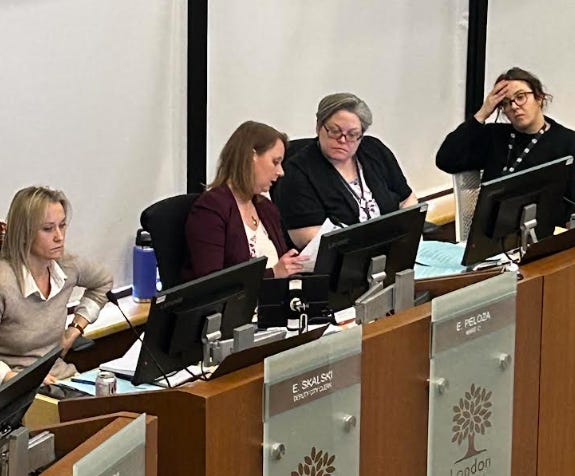
And there was a lot of work being done on the hop, with chats and rewordings of motions, and long delays. By the end Councillor Elizabeth Peloza, as committee chair, was being supported by no fewer than three clerks; I heard her say “the amendment to the amendment to the motion” a few times and it made my heart hurt. People in the gallery laughed a lot, and comically tried to vote to speed things up.
I’m unsure why our councillors didn’t know their own procedures better at this point in their term. And, with easily a million bucks a year in salaries sitting in the staff bullpen, there was a lot of back-and-forth between councillors and staff with questions and answers of various levels of satisfaction for both sides. Kevin Dickins, Deputy City Manager, Social and Health Development, said: “Appreciate we’re trying to get granular but we’d welcome it.” Councillors had questions about when staff would work on this task or that - it’s an election year, tick tock tick tock.
And the idiom of the fan
Getting to the point: where was the leadership? At least 120 people were there to agree to better care for vulnerable people in our society, and somehow it took all afternoon to get it together. The mayor was out of town, and the deputy mayor presented his compromise right at the end – surely he hadn’t just thought of it? I just didn’t understand why this process wasn’t clearly led, with an end goal that could align all parties. That would have been better, surely? It’s not just about process. At some point somebody takes charge and leads the way.
And soon, municipal candidates will go to the polls. Yesterday, and at every opportunity this year, the real conversation is about what they might say on front porches in the fall. Every motion, every side chat, every perceived achievement will feed that process. It’s visible in the council chamber – repeated phrasing in certain contexts, pointed questions that are more about the question than the answer, lots of praise for ‘how we’re all working well together’ but lots of tension about who might be running - and an inescapable feeling that the clock is running down. Voters expect politicians to stand on their record of achievements and those politicians need to know what they will say.
I can’t wait to see what they come up with. There’s definitely something in the air.
That’s it from me for now. I’ll watch the Planning committee this afternoon, either online or in person a little, and round up all of the week’s issues-based news on Friday. Thanks for reading!
Note on A.I. use: I do not support use of generative A.I. to replace human creativity. I make use of A.I. support only where it can make me better or faster at a task I would already have undertaken. These reports were produced with help from an assistant created in ChatGPT, speeding the process while retaining editorial control in the hands of a human (me). I’m happy to discuss this.
Raw notes from Community and Protective Services, January 26, 2026
Here are notes from my bot, mostly just the basics from the meeting. I’m including these for better coverage, for those who want it. Open to feedback, of course.
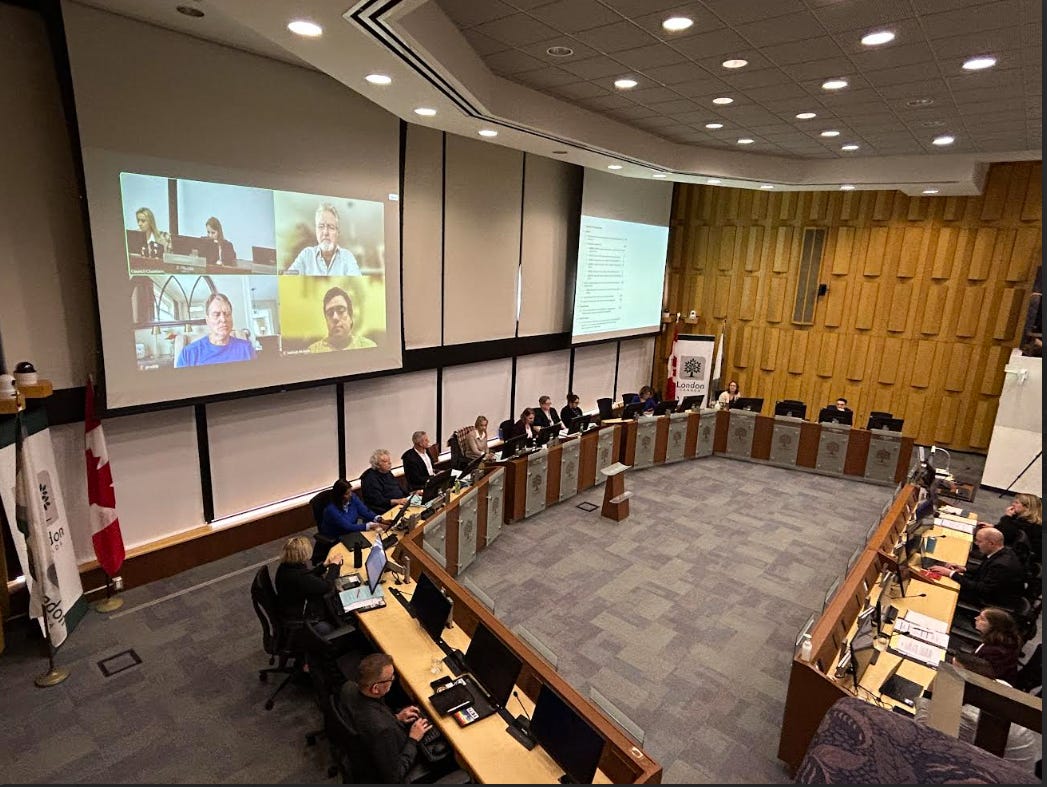
City of London Community and Protective Services Committee
Date: January 26, 2026
Location: Council Chambers, City Hall
Chair: Councillor Peloza
Mayor: Absent
Acting Mayor: Councillor Lewis
Attendance
Voting Members Present (Committee Members)
Councillor Peloza (Chair)
Councillor Stevenson
Councillor Lewis (Acting Mayor)
Councillor Hopkins
Councillor Trosow
Councillor Ferreira
Other Councillors Present (Non-members)
Councillor Pribil (in person)
Councillor Franke (in person)
Councillor Rahman (in person)
Councillor Cuddy (online)
Councillor Hillier (online)
Councillor Lehman (online)
Councillor McAlister (online)
Public Attendance
Approximately 90 people in the public gallery.
Procedural Notes
Councillor Lewis, as Acting Mayor, was confirmed by the Chair as having mayoral powers, including the ability to move motions at committee.
Procedural challenges were addressed with the assistance of three clerks.
No councillors attending online spoke or were called on to speak during discussion.
Agenda – Consent Items
The following items were carried on consent:
Item 2.1
Item 2.4
Item 2.5
(Vote counts not stated.)
Remaining agenda items were pulled from consent for discussion.
Good Neighbour Agreements (Item 2.2)
Councillor Lewis had an amendment prepared.
Councillor Trosow moved a referral back to staff, which procedurally takes precedence over amendments.
As a result, Lewis’s amendment may not be considered.
However, Trosow withdrew the referral motion, saying he would vote against the main motion.
Lewis was offered the opportunity to speak to his amendment before delegations, but declined.
Members discussed a compromise motion:
Maintain funding for London Cares for one additional year.
Conduct consultation regarding future years.
4.1 Reallocating Community Grants to Capital Projects only
Put forward by Councillors Rahman, Lewis and Peloza.
Public Delegation
Maureen Cassidy, Pillar Nonprofit Network, asked the committee not to proceed with proposed changes to the grants program, saying non-capital grants are a lifeline for local orgs and those in need.
Councillor Discussion
Councillors Trosow and Ferreira spoke about the need for stable funding for non-profit organizations.
Ferreira stated an intention to bring a future motion to restore community granting “in full” at the appropriate committee.
Chair Peloza said any increase to funding would need to be addressed in a future budget cycle.
Vote
A motion related to the grants stream failed on a 3–3 tie.
In favour: Peloza, Lewis, Rahman
Opposed: Hopkins, Ferreira, Pribil
Item 4.2 — Temporary Warming Centres
Delegations
Multiple public delegations spoke.
Submissions were emotional; visible distress in the gallery.
One speaker, a formerly homeless man, said he had served prison time for trespassing to avoid freezing.
Tone of delegations was respectful but frustrated.
Funding
Council seeking to lower threshold for opening centre; and to add further homelessness provision – extra beds.
Estimated cost discussed: approximately $250,000, and later closer to $300,000.
Staff indicated they would find funding within the existing budget.
Cost described as variable, depending on weather and number of extreme cold events.
Timing
Implementation would take effect Feb. 10, subject to Council approval.
Scope / Discretion
Franke noted warming centres were not opened during recent ice storms.
Proposal would give staff discretion to open centres during extreme weather events, not only cold thresholds.
Councillor Remarks
Trosow noted cross-council support for improved services and lower thresholds; named others, including Stevenson, as partners.
Stevenson said collaboration was positive but criticized the balance between outreach services and indoor supports, stating indoor services were closed to fund outreach.
Stevenson cited an example involving Boyle Community Centre, where:
Three buses of young children were outside as overnight users exited.
103 people exited at the same time the previous night.
She had questions about children being around people experiencing homelessness.
Lewis raised concerns about procurement delays.
Peloza agreed procurement processes could slow implementation.
ENDS ENDS ENDS
So happy about this! -15 is inhumane! I've emailed the mayor and councilors several times about this!