



September 11, 2026
You know that concrete pad between London’s City Hall and Centennial Hall? It’s called Reg Cooper Square. A little Google research taught me that it’s named after a long-serving municipal employee.
Many years ago, Reg Cooper Square was a significant gathering space, with a fountain, gardens, benches and even space for special events. YOU’s first “major” fundraising event was held there in 1984, during the UN’s International Year for Youth.
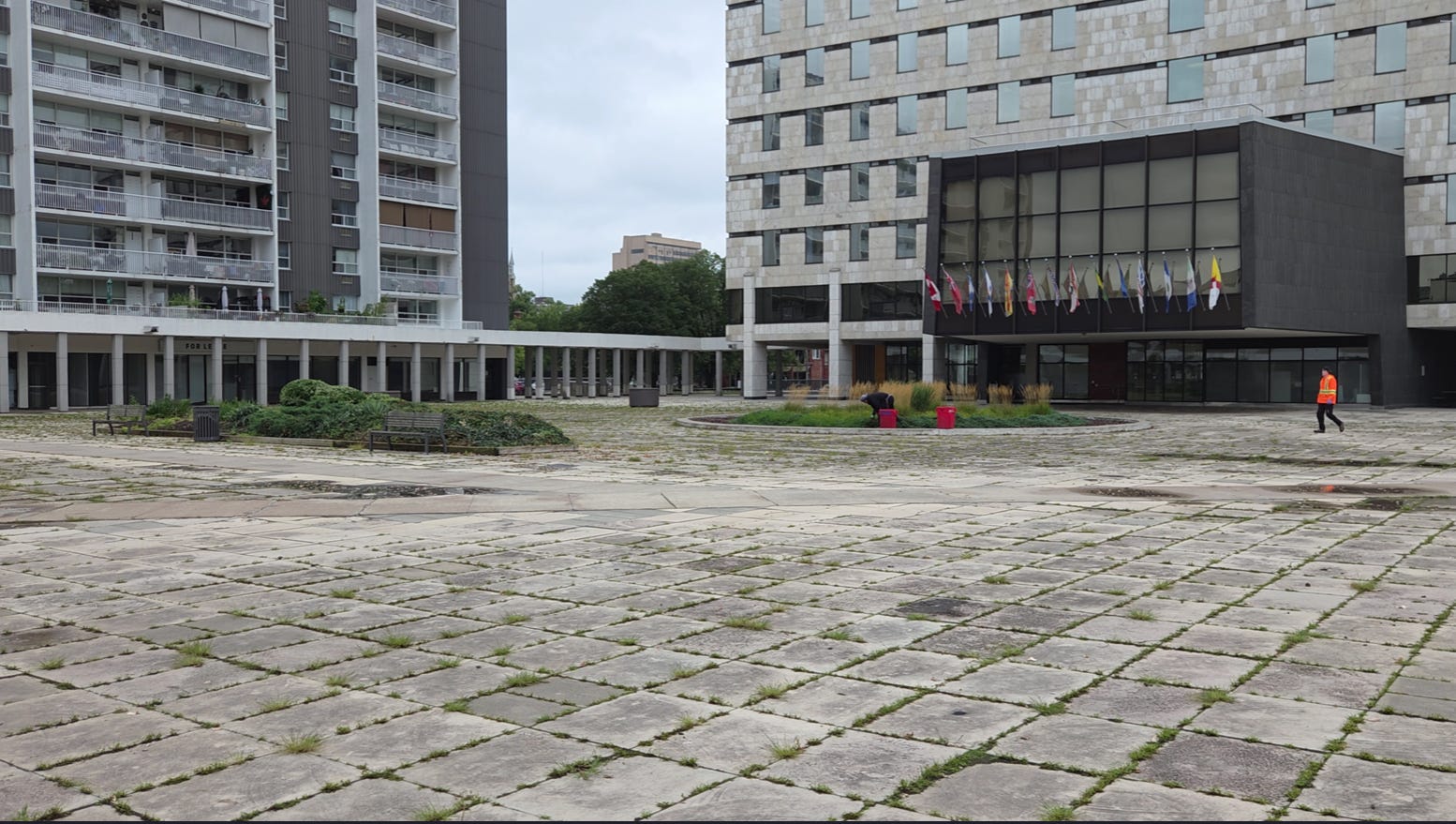
Today, the square has deteriorated to the point where it’s an eyesore across from London’s beautiful Victoria Park. And that got me wondering: instead of simply asking how we might restore Reg Cooper Square to its former glory, should we be asking a much bigger question about the entire site?
My Loon colleague, Matt Brown, and I explore that question in this week’s Steve’s Reflections.
London’s existing City Hall is no longer adequate for the city’s needs. At the same time, the City has made significant investments in the downtown and has identified filling vacant downtown office space as a priority.
So what if we looked at moving City Hall to a more centrally located downtown building—perhaps one of the many existing office buildings that are currently underutilized or vacant?
And what could that make possible at the existing City Hall site, including Reg Cooper Square and Centennial Hall? Could this become an opportunity for significant renewal, new public space, additional housing or other uses that would better serve London’s future?
This isn’t about suggesting that we already know the answer. It’s about asking whether we should be exploring the possibilities.
Council has considered relocating City Hall before, including pursuing the Bell building at Dundas and Talbot roughly 20 years ago. Perhaps it’s time to take another look.
We all have concerns about affordability and taxation. But perhaps there is also a business case for looking at the bigger picture: rather than continuing to invest in a building that no longer meets London’s needs, could we redirect that investment in a way that gives us a better City Hall, brings more workers into the heart of downtown, and unlocks the potential of one of our most prominent downtown sites?
That’s the question Matt and I explore in this week’s Steve’s Reflections.
ADVERTISEMENT

Steve’s Reflections is sponsored by Old East Village BIA
Supporting independent local journalism in our community.
Please note: It is The Loon’s Policy that all editorial content is independent of any and all sponsors.
The Loon (London Ontario Online News) lineup
New content every day
We’re teaming up to send you a new feature every weekday:
Monday - Buckle Up - podcast with Matt Brown, SPONSORED BY HAMILTON ROAD BIA
Tuesday - Tour with Cedric Richards - SPONSORED BY LONDON BICYCLE CAFÉ
Wednesday - City Hall Notes by Mike Donachie - SPONSORED BY SPERO LAW
Thursday - the Forest City Arts and Culture Roundup by Diana Tamblyn - SPONSORED BY DOWNTOWN LONDON
Friday - Reflecting - with Steve Cordes SPONSORED BY OLD EAST VILLAGE BIA
And free on Fridays: the ROUNDUP, briefing you on the stories you need to know, gathered in one place. Regular analysis of the issues affecting London and the region.
London Ontario Online News (The Loon) is a reader-supported publication. To receive new posts and support my work, consider becoming a free or paid subscriber.
The Loon raises a fair question: should London keep investing in the existing City Hall, redevelop the site, or move into existing downtown space?
But before we start another big vision, taxpayers should see the whole file.
London has been studying its accommodation needs for years.
Council approved moving ahead with redevelopment of the City Hall campus in 2024.
The City then tested the market. There was strong initial interest, but only two submissions were received and one withdrew. Council cancelled that procurement and ordered a deeper review.
Meanwhile, the City's own budget says major City Hall systems are beyond their expected lifecycle and that capital renewal has been deferred while decisions about the building's future were being made.
So before another study, proposal or shiny rendering, why not put everything on one page?
What has already been studied?
What did those studies cost?
What has already been spent?
What is already committed?
What repairs cannot be avoided?
What would staying cost over 30 years?
What would rebuilding cost?
What would buying an existing downtown building cost?
What would leasing cost?
How much office space does the City actually need in a hybrid-work world?
How much leased space could be eliminated?
What is the market value of the existing City Hall lands?
What housing could realistically be built there?
What would happen to Centennial Hall?
What happens to Reg Cooper Square?
What taxes would new private development generate?
What transition costs would taxpayers carry?
What borrowing would be required?
What is the interest cost?
What is the lifecycle cost?
And perhaps most importantly:
What did we learn from the procurement that just failed to produce meaningful competition?
The question shouldn't simply be:
"Should we move City Hall?"
It should be:
"Which option delivers the required municipal services at the lowest whole-life taxpayer cost while getting the greatest value from the assets London already owns?"
Put STAY, RENOVATE, REDEVELOP, BUY, LEASE and HYBRID side by side.
Same assumptions.
Same time horizon.
Same accounting.
Same taxpayer ledger.
Then let Londoners see the trade-offs.
We've spent years looking at City Hall one decision at a time.
Maybe it's time to measure the whole pile before adding another layer.