


Disclosure: I recently had wrist surgery and have been completing each column through a dictation device on my computer.
Welcome back to another look at The City with Cedric Richards, where you can expect a look at the Forest City with a fresh perspective. Thank you to all of you who have chosen The Loon in reading and subscribing to us each day.
It would be so easy to tell you who won the municipal elections of three weeks ago. It would be so easy to tell you who lost. But I think we should dive into the numbers a little, and check out how we got to electing our mayor and 14 councillors, all of whom will be formally sworn in at RBC Place tonight.
The Polling Districts
The City of London recently released the election results with poll-by-poll data, as well as extensive turnout figures. It was like Christmas for someone like me.
London has 200 polling districts. 199 of them are in-person, with one encompassing an at-large “vote by mail” option. 10 of the 199 districts are advance polls, in which you can vote anywhere in the city no matter what constituency you live in. The 189 Election Day polls are scattered across the city, divided amongst the 14 constituencies of London. Some of them cover specific tracts of land, but others cover retirement homes, hospitals, among other institutions. Many of these institutional and advance polls have varying turnouts with low numbers of raw voters, which produce odd results. For example, the third- and fifth-place candidates in Ward 7 both tied for first in an advance poll outside of the ward.
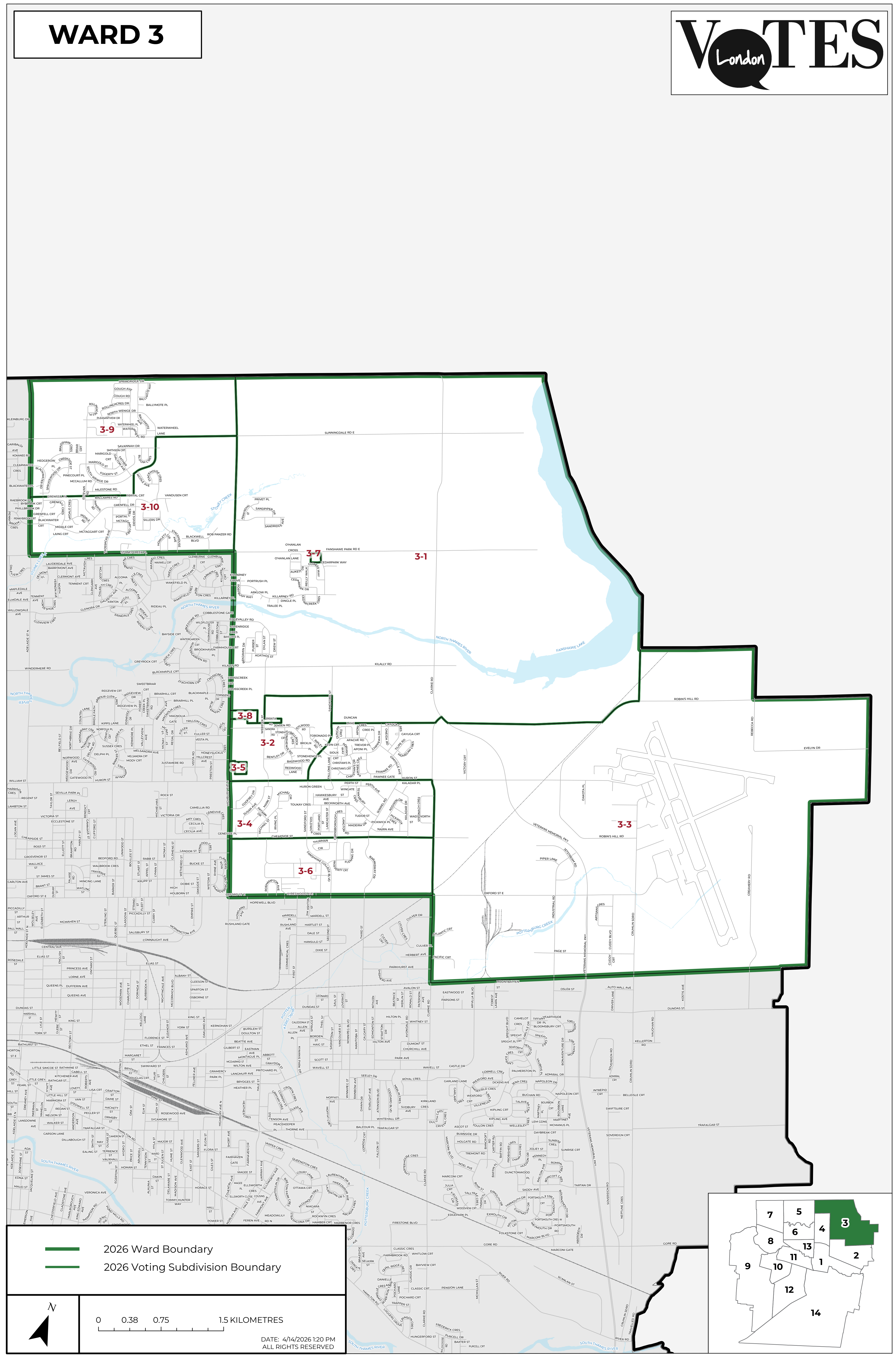
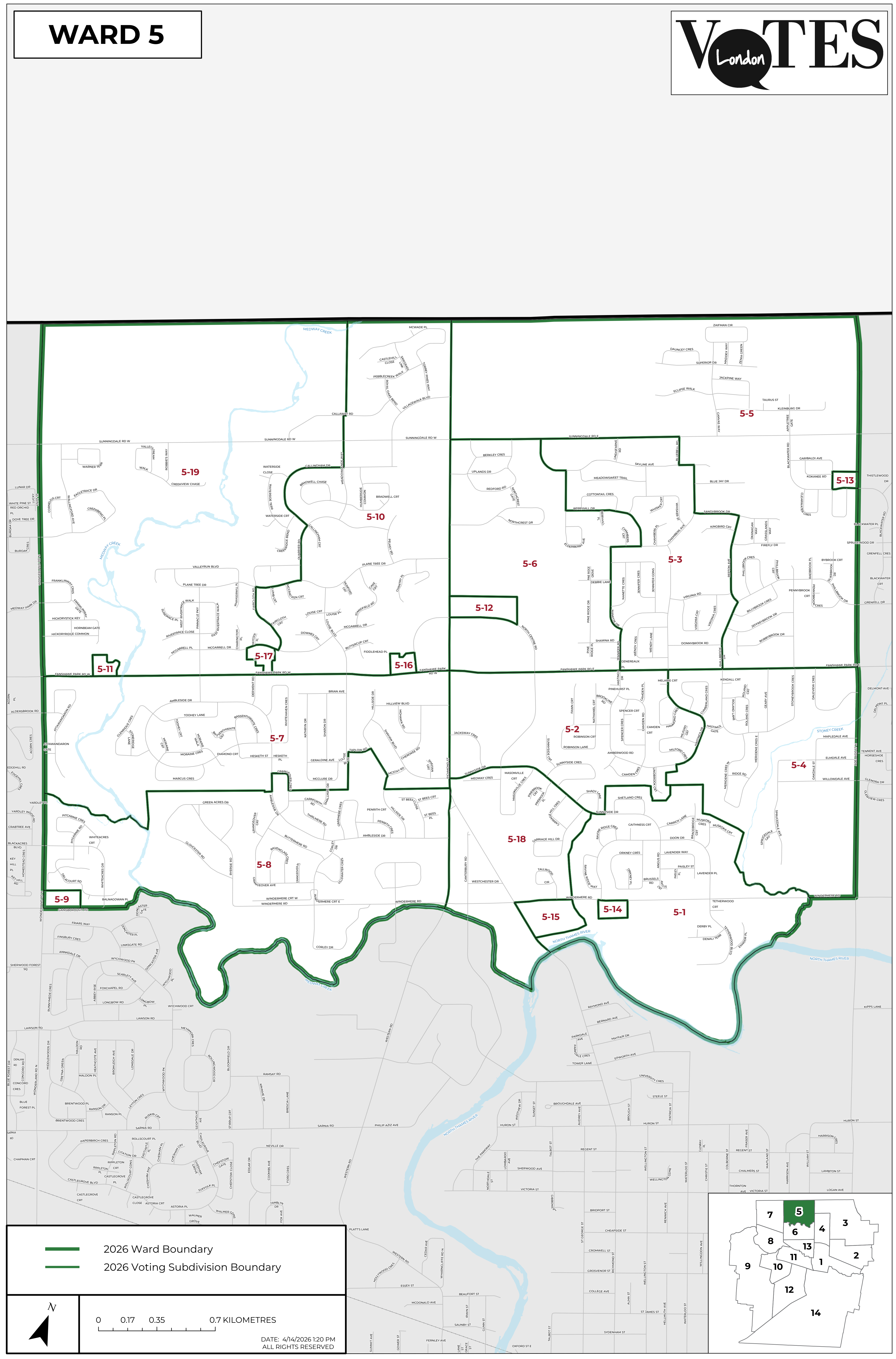
A ward can have as high as 19 polls, as seen in the north end of Ward 5, or as low as 10 polls in Ward 3. Some polling districts share voting locations, such as Wilton Grove Public School or the Hamilton Road Seniors Community Centre. The results by district give us a better view of who voted where, and why.
The mayoral race
Before we dive deep into the 519, I would like to take you to a place called the 905.
The 905 is a region that wraps around the city of Toronto, consisting of the City of Hamilton and the Regions of Peel, York, Halton, Durham, and Niagara. What does this have to do with a London election race? One underlying philosophy.
Any political observer will tell you the secret to winning an election in Ontario both provincially and federally. The road to the government runs through the 905. You cannot win a government without winning in the 905, and winning big. It is seen as the ultimate swing region and more diverse than other places in Canada. Places immediately adjacent to the 905, such as the City of Toronto or rural areas like Dufferin and Simcoe counties, are seen as places where voters already decided how they will mark their ballots a long time ago. But in the 905, it’s where voters are engaged, their opinions are not set in stone, and there are votes to be had.
This takes us back to London, where it appears that you cannot win citywide, without winning in vote-rich places in the north and west ends.
How did the candidates fare in the mayoral election?
Josh Morgan
Josh Morgan (hereinafter referred to as “Mayor Morgan”) won every ward, as well as the advance polls and the vote by mail. But how much did he win by?
Ward 11 gave the mayor his best result, with nearly 51% of the vote, and was the only ward to give a majority of votes to a mayoral candidate. His next best wards were 6, 8, 5, and 10, where he attained at least 47% of the vote in each of those wards.
Out of 200 polling districts total, Mayor Morgan won 191 of them, tying in two, and losing seven, all to Ward 4 councillor Susan Stevenson. This is the indication that the mayor ran a broad-based campaign.
Susan Stevenson
Susan Stevenson came second in every ward. The seven polling districts she won were:
Ward 1, District 5 - 39% to Mayor Morgan’s 35%
Ward 4, District 1 - tied with Mayor Morgan at 34%
Ward 4, District 4 - 36% to Mayor Morgan’s 34%
Ward 4, District 5 - 34% to Mayor Morgan’s 33%
Ward 4, District 6 - 34% to Mayor Morgan’s 29%
Ward 4, District 7 - 28% to Mayor Morgan’s 27%
Ward 13, District 10 - 42% to Mayor Morgan’s 33%
Ward 14, District 9 - 45% to Mayor Morgan’s 28%
This suggests that she had a reliable base of support in her then-constituency of Ward 4, which was strongest between Barker Street and Highbury Avenue North. Within this area are a lot of blue-collar and lower-income areas. Of note, the newer parts of the reconfigured Ward 4 located in Northridge did not give their vote to Stevenson. This creates a bit of a “What if?”, a hypothetical if Stevenson decided instead to seek a second term rather than running for the mayoralty. Stevenson may have also had a rural base, when you consider the Ward 14, District 9 result. She also had one of her best vote shares among non-winning polls, coming within two percent of winning in Ward 9, District 10, which covers communities like part of Lambeth, Scottsville, and Tempo.
In three wards, Wards 1, 4, and 14, Stevenson came within 10 percentage points of the incumbent mayor. Ward 2’s margin was just over 10 points. Many of the wards with tight margins are generally London’s more low-turnout wards. Additionally in past elections, socially and fiscally conservative mayoral candidates have done well in Ward 1, and East London at-large.
Third Place and beyond
But one of the more interesting findings is this: who came in 3rd place? Citywide, Kirsten Krose came third in the popular vote. The only poll that Krose came close to winning was a three-way tie in Ward 11, District 13 in The Waverley Retirement Residence. Mayor Morgan, Stevenson, and Krose all received three votes each. Krose also placed second in Ward 5, District 14 in the Congregation of the Sisters of St. Joseph, with 29% of the vote. It appeared that she was running a broad-based campaign; her best performances were scattered across the city.
But at the ward level, third place gets a little interesting. Bronagh Joyce Morgan (hereinafter referred to as “Bronagh Morgan”) came third in Wards 1, 11, and 13. Wards 11 and 13 are constituencies with a lot of vocal, civic-oriented liberals. The third-place finish in Ward 1 was mainly buoyed by a strong 3rd place showing District 12, which is Old East Village west of Quebec Street. Where Bronagh Morgan came third in a ward, Krose placed fourth.
On Election Day, Bronagh Morgan placed second in these districts:
Ward 6, District 4 - 21% of the vote
Ward 6, District 5 - 23% of the vote
Ward 13, District 5 - 19% of the vote
Ward 13, District 6 - 17% of the vote
Ward 13, District 13 - 20% of the vote
Bronagh Morgan also cleared 10% of the vote in several districts, each throughout Wards 6, 11, 13, and the westernmost part of Ward 1. This suggests a support base of the idealistic left, whose message has a hard time reaching places north of Western University, west of Wonderland, or south of Commissioners, and east of Highbury.
Former Ontario Liberal Party candidate Tariq Khan placed fifth citywide and in all wards. His best ward performance was Ward 7, where he garnered nearly 6% of the vote. His best poll was Ward 8, District 9 which includes part of the Oakcrossing neighbourhood, and several high-rise buildings along Blythwood Road. Khan received 14% of the vote there.
The citywide takeaway
No matter where a candidate is in the political spectrum, there are a few lessons to be learned from where the votes went in this campaign. As I noted two weeks ago, there are votes to be earned in the west and north edges of London. These are the people who turn out to vote and if you listen to them, the election will go in your favor.
For centrist and liberal candidates, the east end wants assurance that you are listening to them. We have heard time and time again that this is the most left behind part of London, and that feeling of being left behind is ignored to the peril of not just centrist candidates, but candidates across the spectrum.
And for the left, while places like Wortley Village, Old East Village, and the downtown core are part of the cultural heartbeat of the city, you cannot build a winning coalition with those places as the backbone for a mayoral campaign. You have to also go where the votes are in the suburbs, and you have to speak their language - literally and figuratively.
For the right, I’ve been looking at some of the reactions to the election results both citywide and at the ward level. The right must also be mindful of the onus being on the candidate to run a palatable campaign with a message that sits right with prospective voters. If that candidate is soundly defeated, that’s not on the electorate, that is on the candidate themselves. The candidate would do better to run on a platform that resonates with all Londoners and not just those who are ideologically aligned.
The ward races
From the city, let us dig deeper and explore each of the wards and how those contests were won and lost.
Ward 1
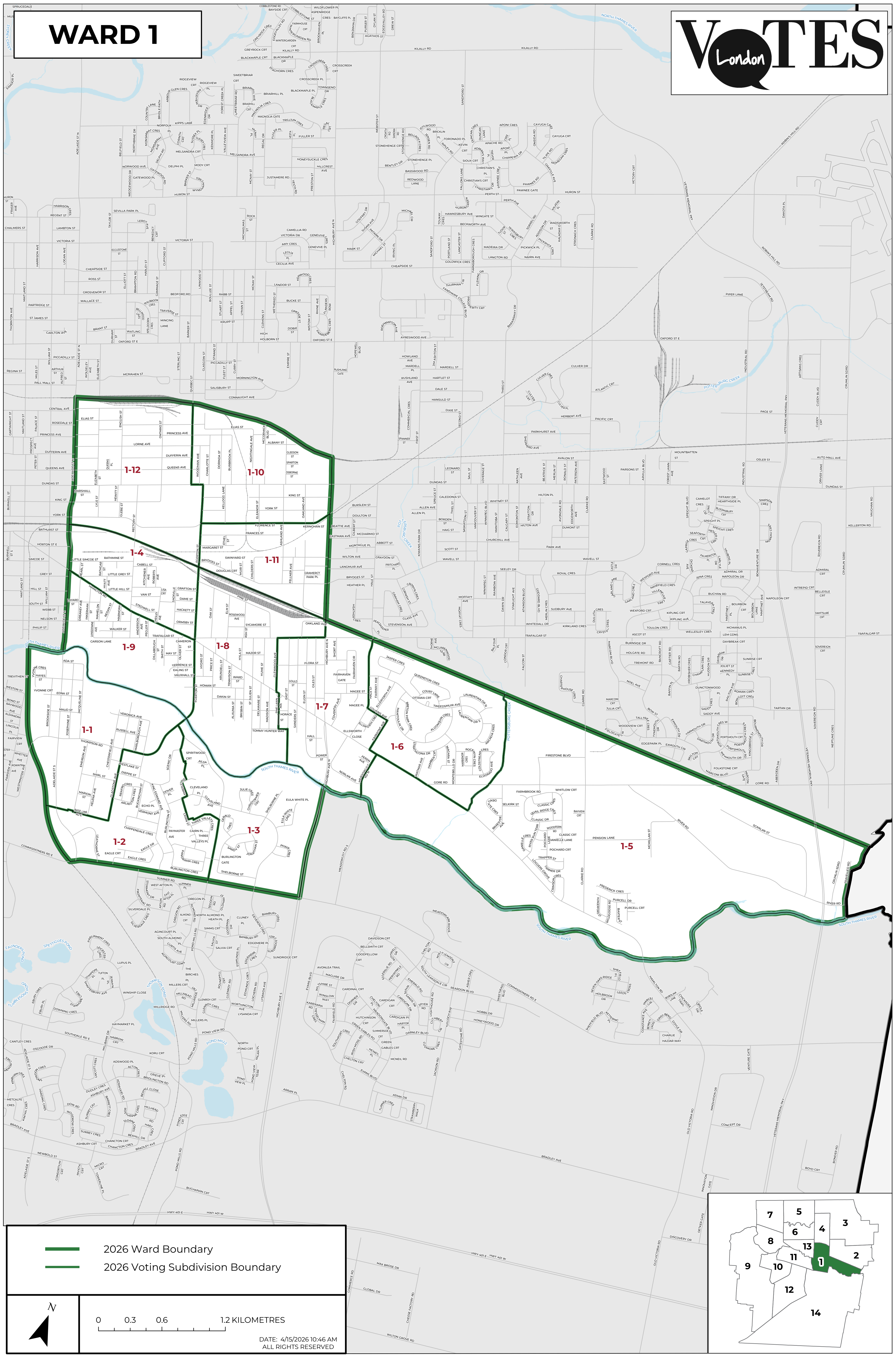
The race that many people thought was going to be a Roger Caranci win by a landslide or very close turned out to be a 17-point Hadleigh McAlister victory in the ward. It appeared that the incumbent advantage was real, with McAlister winning in the vast majority of polls. The only poll on Election Day that McAlister lost was District 5, which comprised the east end of the ward. But that was by a tiny four-point margin, 50% to 46%. Hadleigh McAlister won by a landslide inside the newest part of the ward, in Old East Village. In District 10, which comprises Old East Village east of Quebec Street, McAlister won 58% to 39%. In District 12, which is between Adelaide and Quebec Street, McAlister won with a two-to-one margin, 64% to 32%.
Ward 2
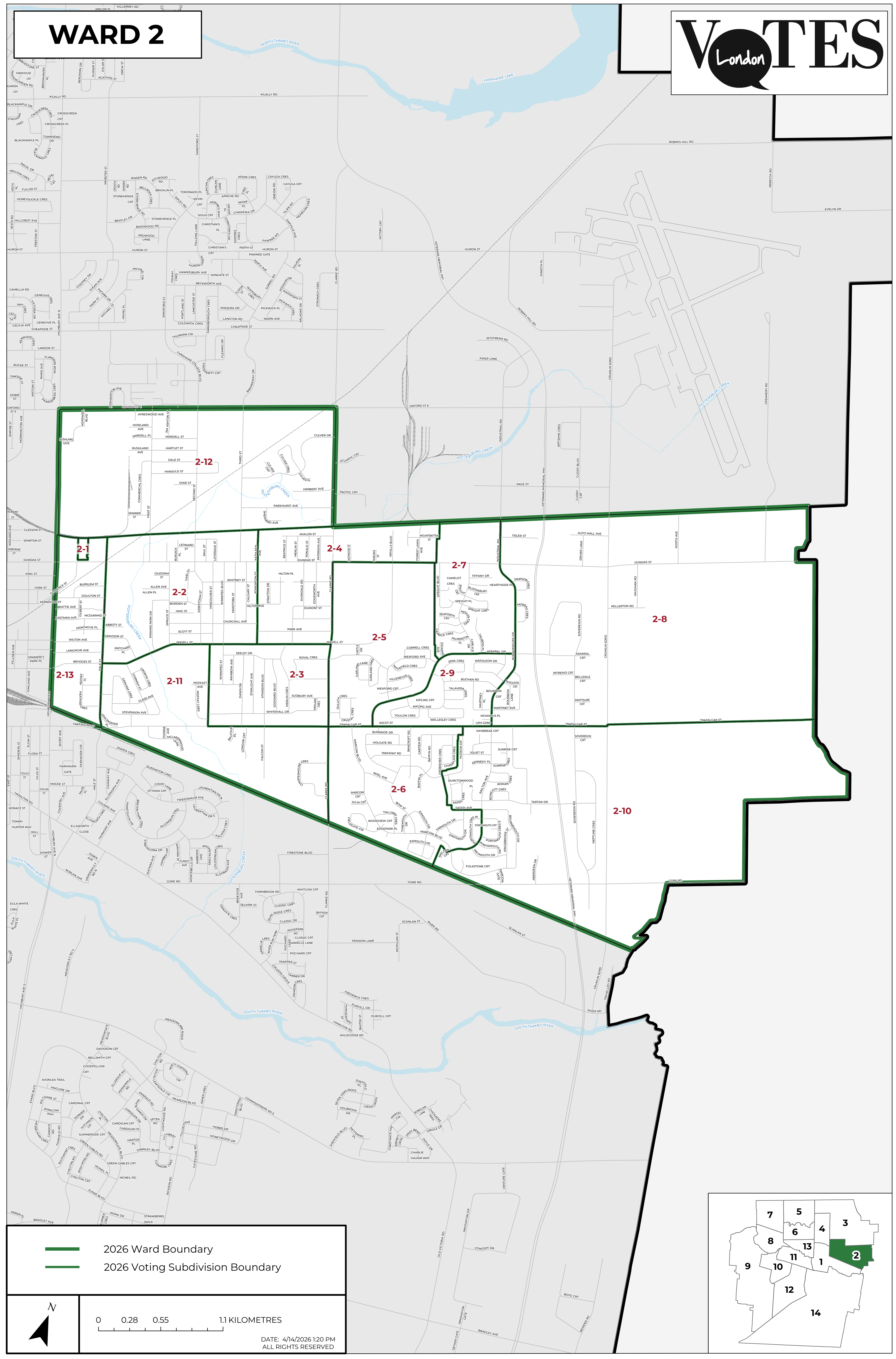
The incumbent deputy mayor and councillor won an absolute majority of votes in all but two polls. Those outliers were advance polls located outside of Ward 2. Shawn Lewis also won his highest number of raw votes with 4,138 in his third election.
Ward 3
At the ward level, and at the district level, it was a narrow race. Peter Cuddy and Ben Durham split most of the polls here, with no candidate garnering a majority of votes on Election Day. Cuddy kept it competitive in polls that remained within Ward 3, such as District 1 which contains some extant rural areas and Fanshawe Lake. Peter Cuddy and Riya Phillip tied for first in District 5 in the Kensington Village retirement home. Durham did exceptionally well in Districts 9 and 10, which were formerly a part of Ward 5 and located north of Fanshawe Park Road. This was likely the gamechanger that gave Durham the win to become the only candidate to defeat an incumbent.
Ward 4
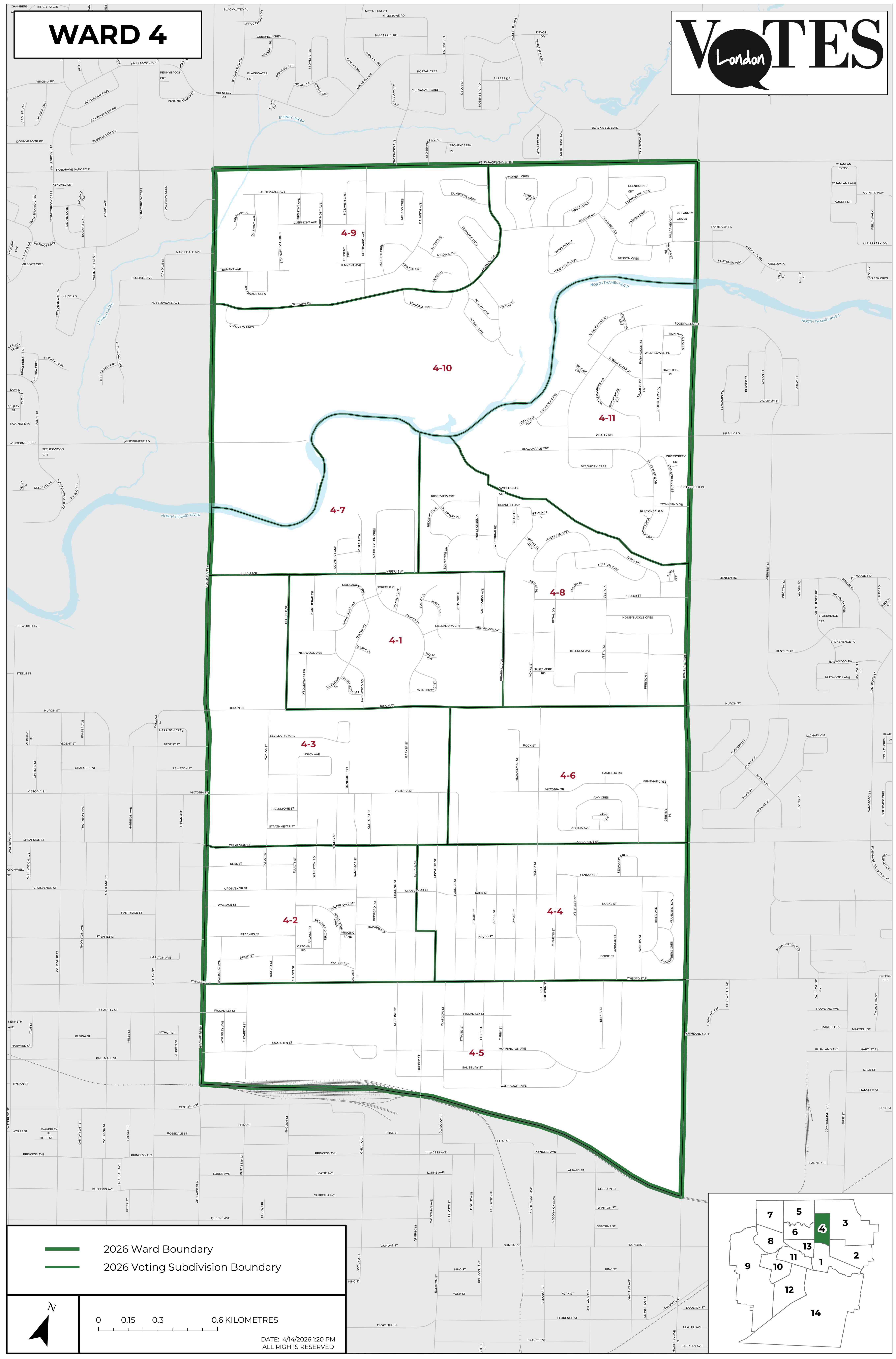
Former two-term councillor Stephen Orser played spoiler in this race, and likely led to the narrow win carried out by Tom Cull. Where Mario Jozic won a poll, it was by a narrow margin. Where Cull won a poll, the gap was much wider. In some Districts such as 3, 4, 6, and 8, Cull’s vote share was smaller than the combined vote shares of Jozic and Orser. Stephen Orser did win one poll - District 7, which lies north of Kipps Lane, and was one of the few that went to Susan Stevenson in the mayoral election.
Ward 5
This is one of those “nothing to see here” contests, where Corinne Rahman won nearly every poll. The incumbent tied with Mary Blake Rose in District 13, a long term care home, and lost two other tiny polls to Rose with one also being located in a long term care home and another advance poll located outside of the ward. Each of the polls contained handfuls of votes, which did not make a difference in the grand scheme of things.
Ward 6
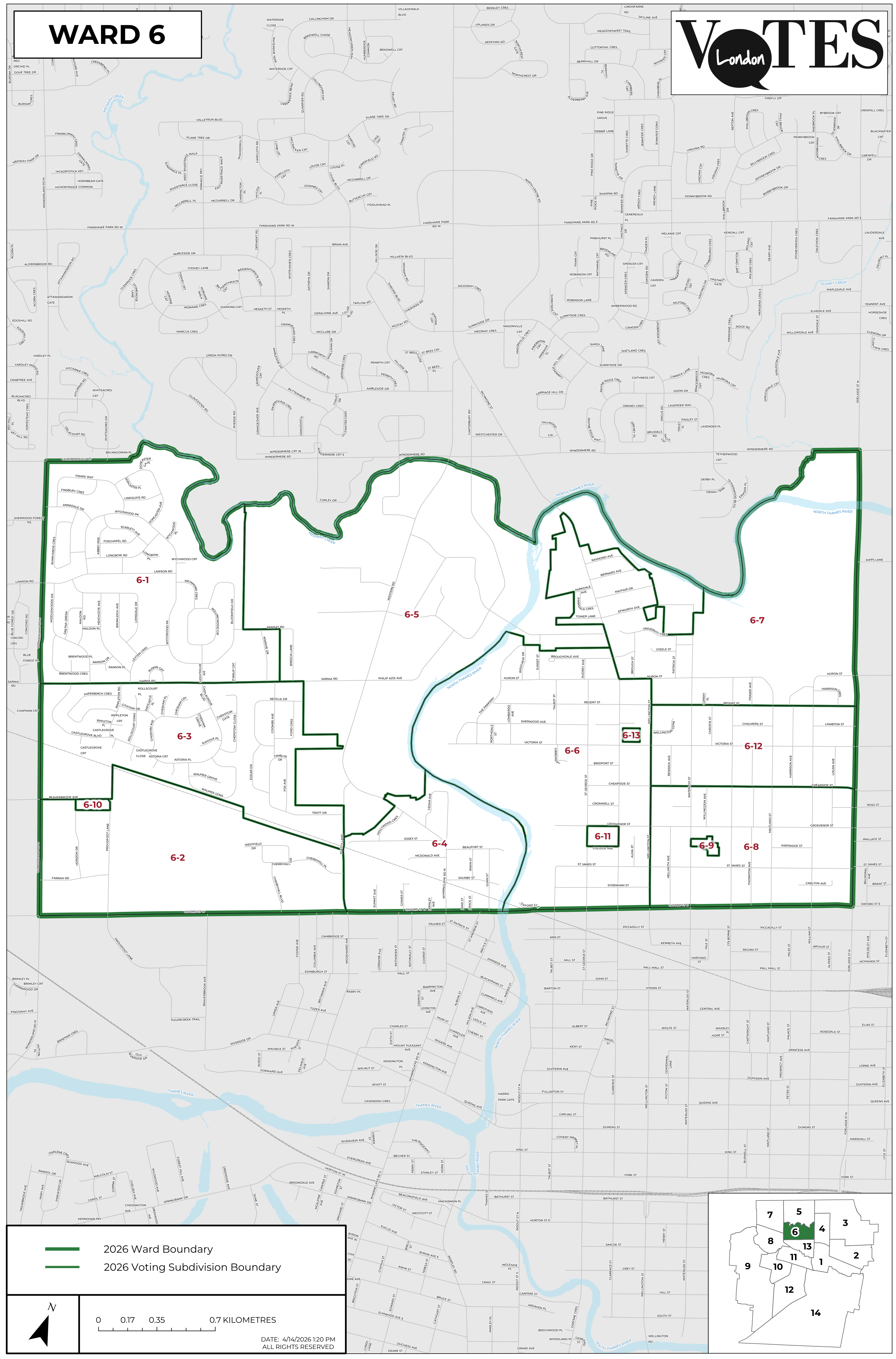
This was a ward where Sam Trosow was seen as being very vulnerable, having won in 2022 by 299 votes. This time, the incumbent won with a more comfortable majority where he benefited from vote splitting. He won about 80% of the 24 polls in Ward 6. His weakest results were in retirement homes, where he lost four polls to either Stephanie Marentette or Ian Sterling Leishman. In Districts 1 through 8, Sam Trosow was able to take advantage of a vote split, eking out wins where his percentage was lower than Leishman and Marentette’s combined percentage; both challengers appeared to be running to Trosow’s right.
Ward 7
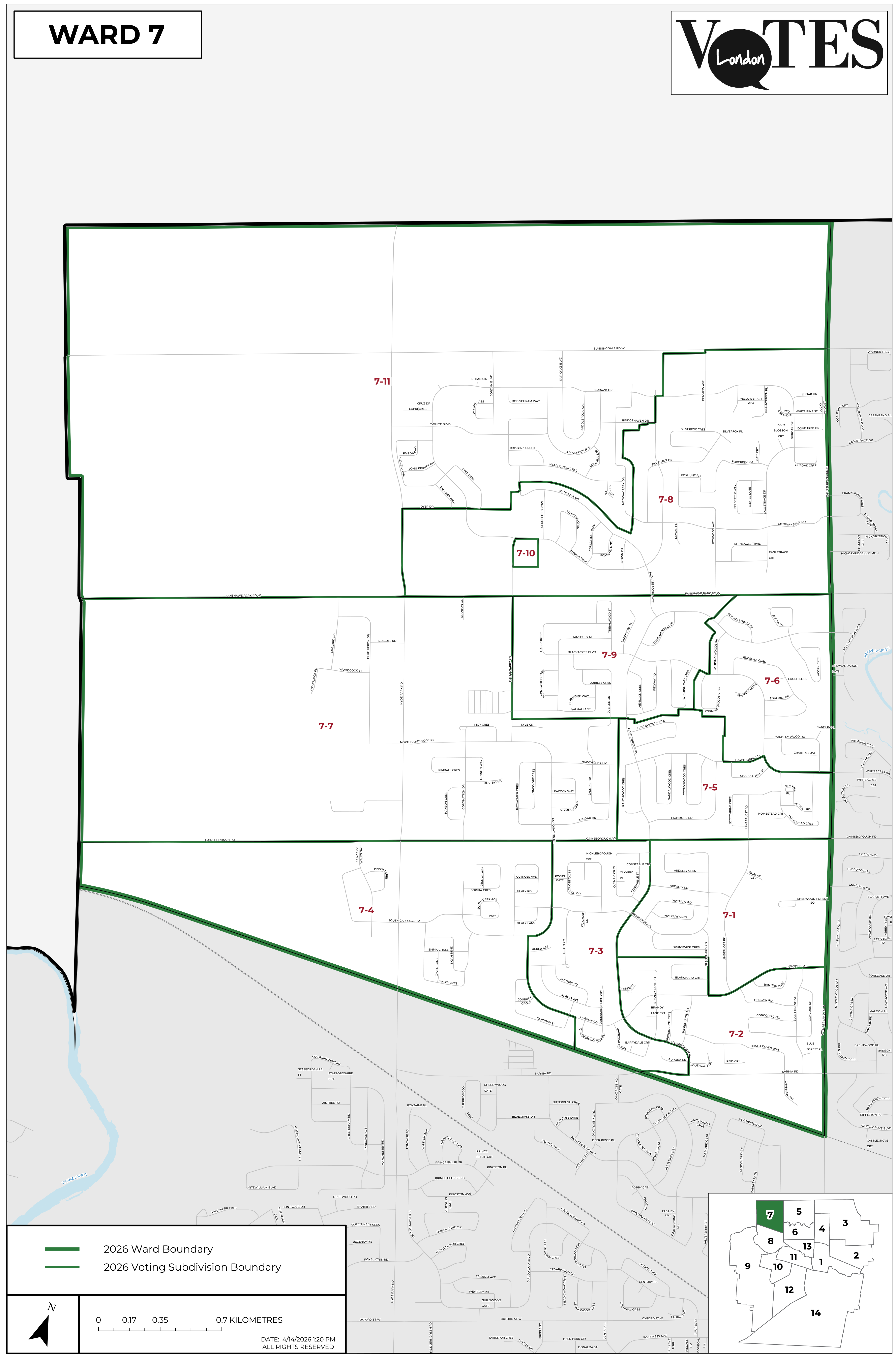
This was a hotly contested crowded field, where Dan Meinen and Jonathan Sher split most of the polls. Meinen’s base appeared to be in the older parts of the ward, where he won Districts 1, 2, 3, and 5. They cover neighbourhoods like Whitehills and Limberlost. Sher comfortably won District 8, located in the east and southern parts of Fox Hollow - the only Election Day poll with more than 1,000 voters turning out. Sher won this district by 149 votes, nearly twice as much as the 82-vote margin he ultimately won the ward with.
Ward 8
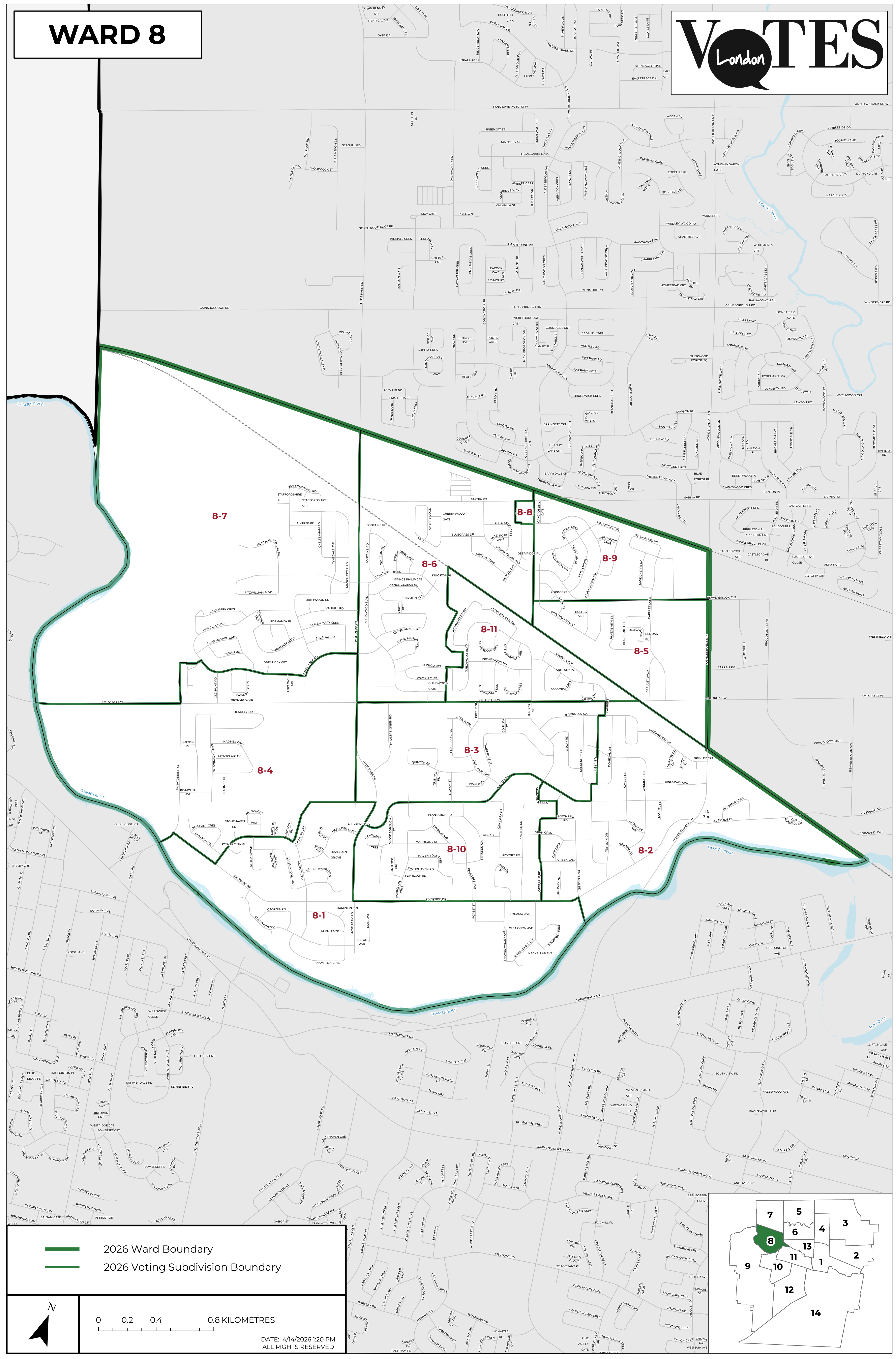
The ward comprising Oakridge was another one of those “nothing to see here” results. Steve Lehman won by a landslide in nearly every poll over both of his opponents. The only poll he lost was the advance poll at Beacock Branch Library (of note, you can vote in any advance poll no matter where you live) in which Coralia Tudor received the only vote recorded at that poll.
Ward 9
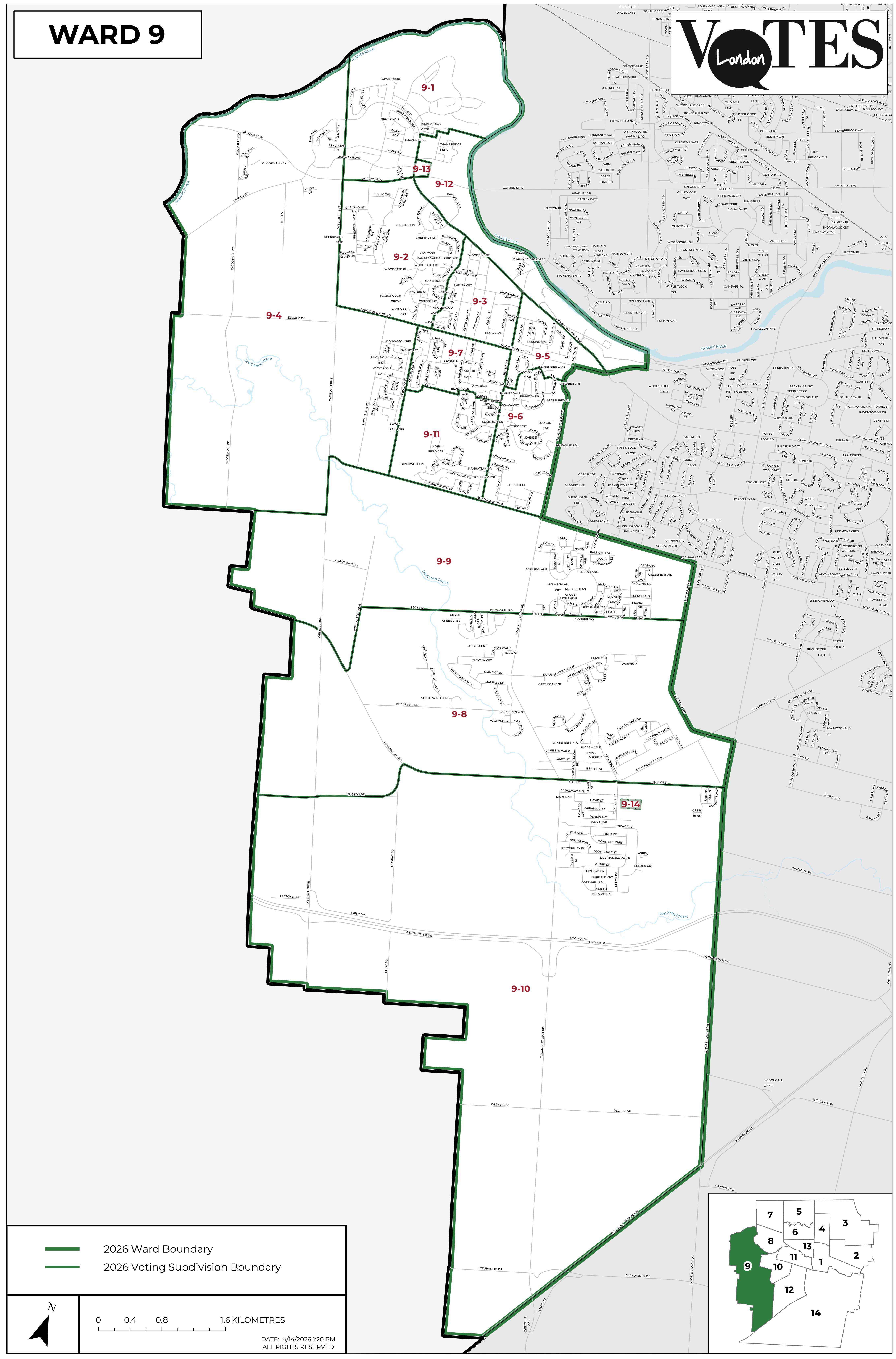
This was seen as one of the nail biters of the night. There were times when it appeared that either Anna Hopkins or Luke Thomas would win this race. But in the end, it was narrowly Anna Hopkins. I noted two weeks ago that constituents would be angry about infill in the west end, looking to vote against Anna Hopkins. In the three Election Day polls that did not go in Anna Hopkins’ favour, they went to Luke Thomas by substantial margins, and they were all located in Lambeth. District 10 consists of much of the ward south of Main Street, and it went to Thomas by 50 percentage points, 63% to 14%. District 10 also contains the Thomas Brothers’ farms, including the market on Colonel Talbot Road. Hopkins’ strength seemed to be turning out voters to advance polls, where she won advance polls at Cherryhill Library and StarTech.com Community Center. On Election Day, she won most of the polls with her best areas being based in Riverbend and Byron.
Ward 10
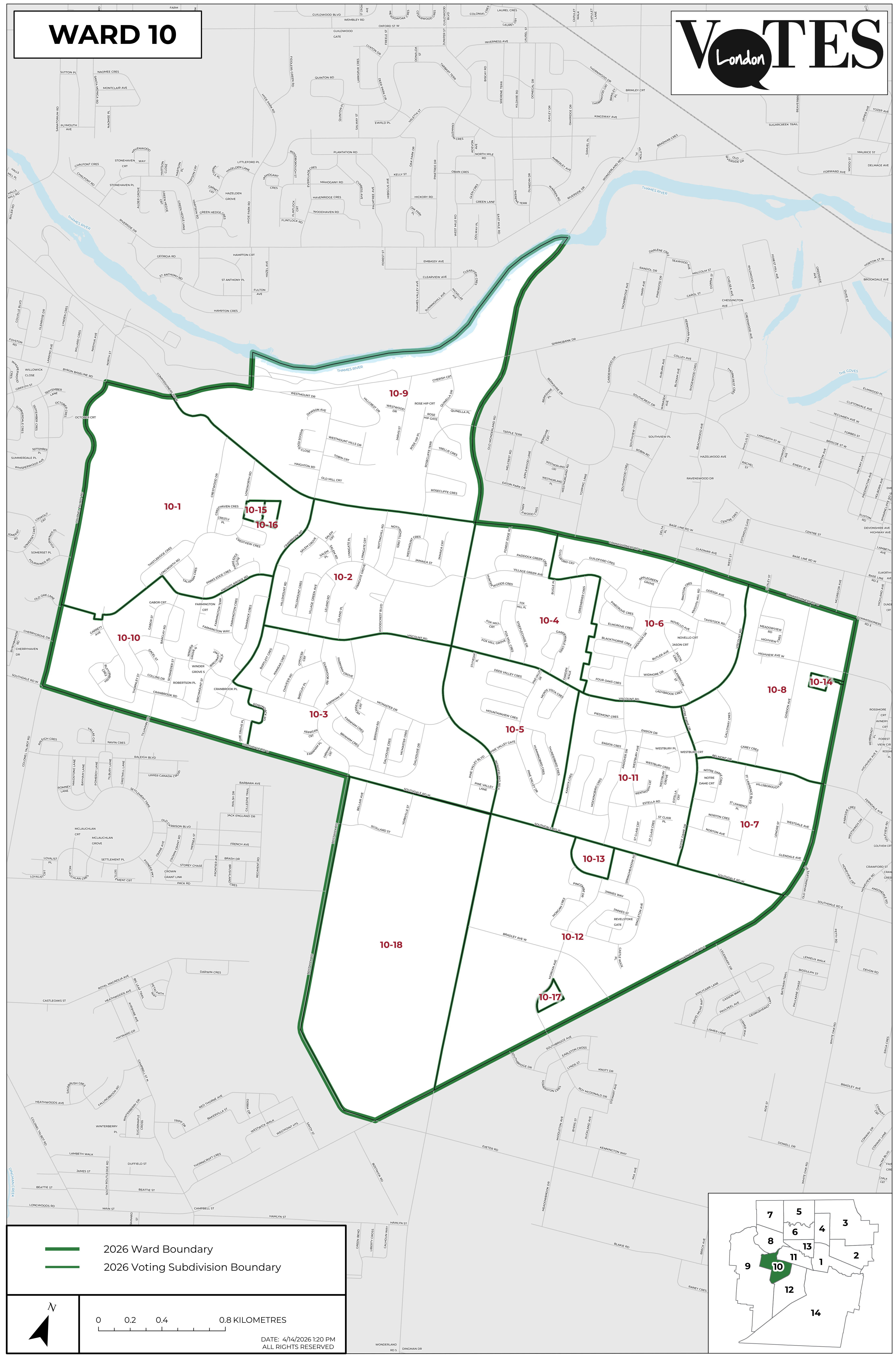
In this ward centring on Westmount, Paul Van Meerbergen won a sixth non-consecutive term in which he defeated candidates who ran to his left. He won all but three polls, with the remainder of polls going in Lois Ward’s favour. This did not matter much as both Ward’s margins and total voters in these polls were minuscule. There were only two polls on Election Day in which Van Meerbergen won an absolute majority of votes; similar to Sam Trosow in Ward 6, the incumbent benefited from a vote split. Lois Ward’s best results were scattered across the ward.
Ward 11
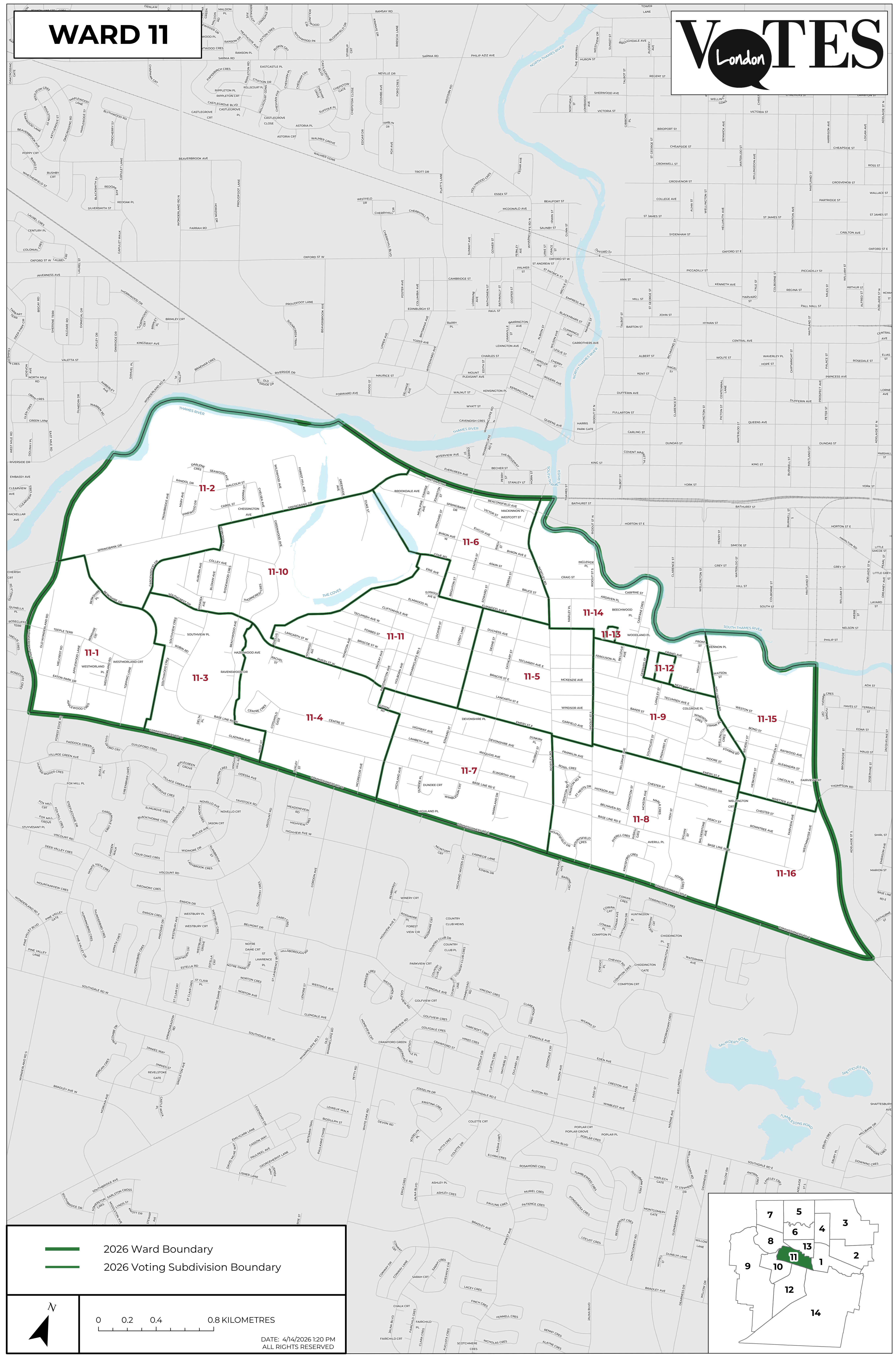
Much like in a few other wards, this one was not close. Skylar Franke defeated Denise Brown in nearly every district, tying with Brown in District 12, a retirement home. The Rowntree neighborhood, which was added to Ward 11, also voted handily for Franke.
Ward 12
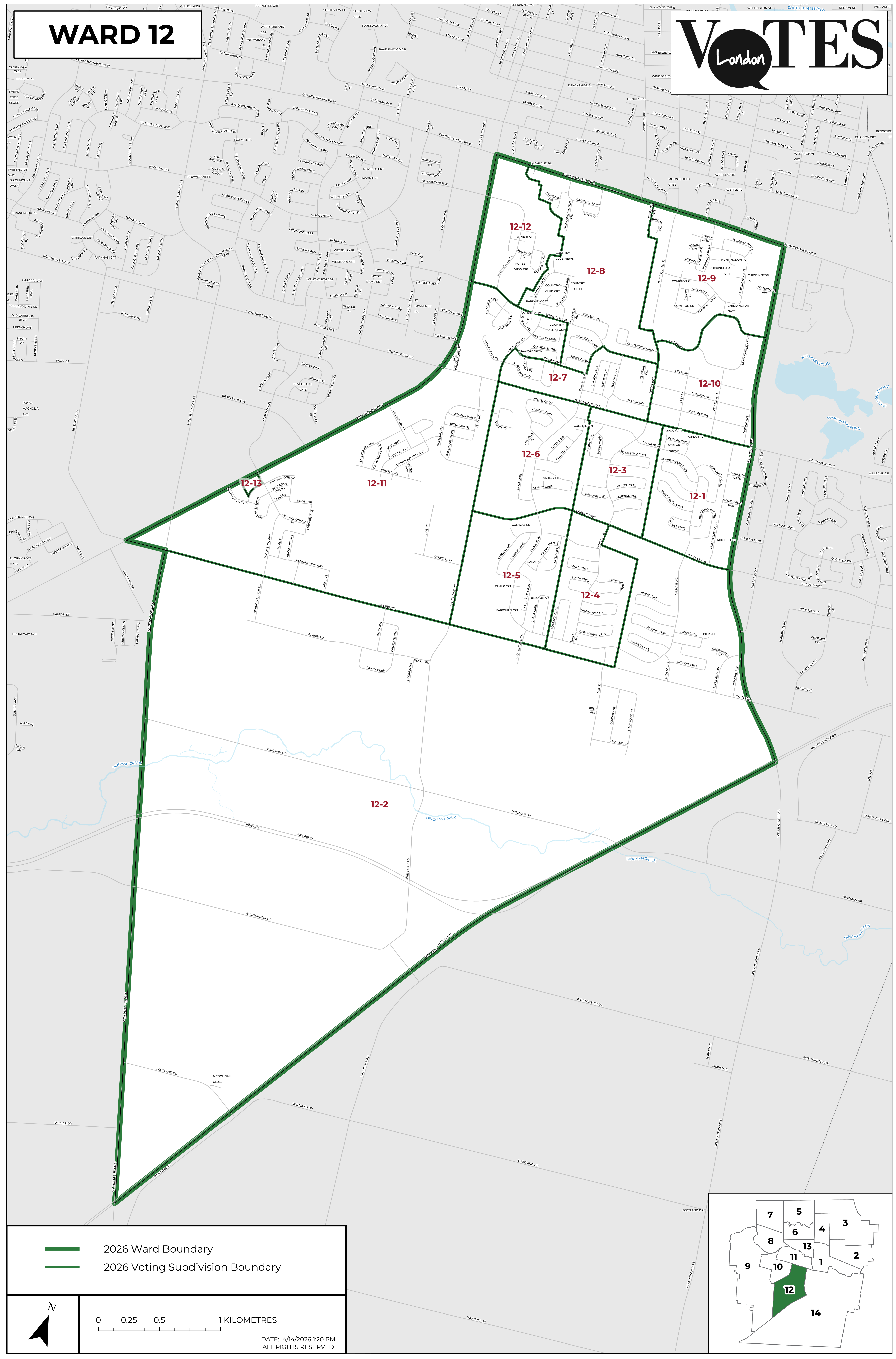
This was another race where it was not even close. Elizabeth Peloza won nearly every poll, attaining no less than 60% of the vote in any district during Election Day. The only poll she lost was the advance poll at Beacock Branch Library in which one vote was cast - for Alexander Main.
Ward 13
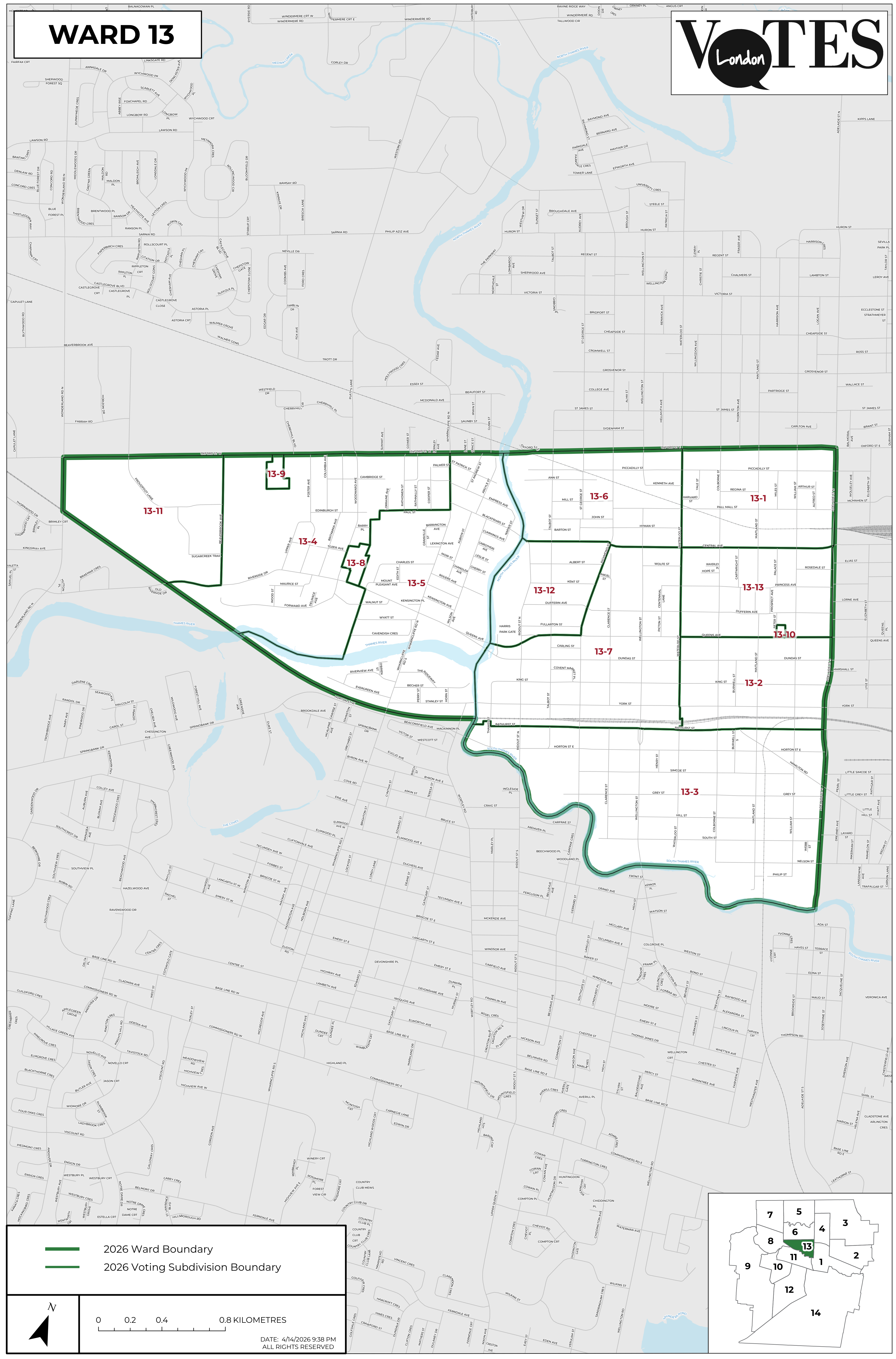
We all thought this core election was going to be very close - until it was not. Ferreira was the only elected candidate to sweep all polls in his ward, including the advance polls outside of his ward. On Election Day outside of the Queen’s Village Retirement Home, Ferreira received no less than 55% in every poll. The incumbent turned a 34-vote margin in 2022 into a landslide throughout the ward. While all campaigns here seemed fixated on the downtown, Ferreira received his highest Election Day result in District 5, which includes Blackfriars and Oxford Park, winning with 78% of the vote. He also received 72% of the vote in District 13, which includes part of Woodfield.
Ward 14
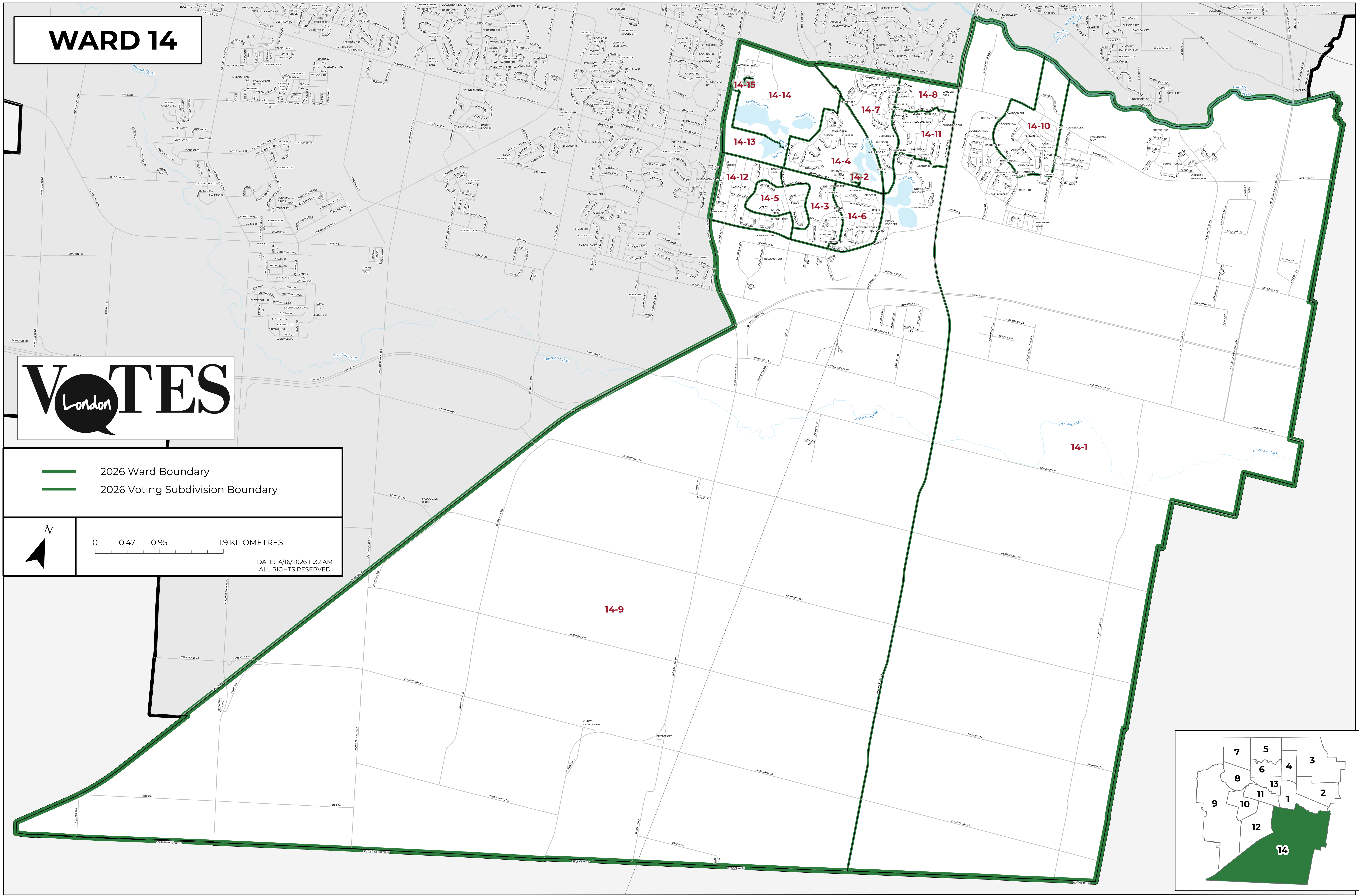
Like Ward 9, this was another case of rural versus urban. Where Jason King won polls, it was handily and it was in places like Districts 1 and 9 in the rural south end of London. District 1 contains the newer parts of Summerside, as well as Innovation Park and rural tracts abutting the border with Central Elgin; King won this district by a 2 to 1 margin, 60% to 29%. District 9 contains Glanworth and much of the ward south of Bradley Avenue and west of Highbury Avenue; King also won this district 59% to 35%. Where Sarah Lehman won a poll, it tended to be in neighborhoods like Glen Cairn and Westminster Park. These wins combined with a 59% to 33% win in District 10, which comprises the older part of Summerside, were instrumental in carrying King over the finish line.
The ward takeaway
11 incumbent ward councillors ran for re-election, and 10 of them won. I have heard in some quarters that it is hardly an endorsement given the low turnout. I respectfully disagree with this. I believe that the returning of most councillors to office is a sign of how campaigns went. Many candidates challenged incumbents on a message of change. But many of them lost. Maybe it has nothing to do with 31% voter turnout, maybe deep down, voters preferred many of the incumbent city council members in this competition of ideas. Public safety was a hot topic during the municipal election. But less discussed was why people did not feel safe parking their votes with challengers. I heard so much about malaise and frustration and anger and yet only one incumbent was defeated and several other incumbents put up Hazel McCallion-type numbers in their wards.
On the flipside of things, yes, the candidates who channelled this frustration with the city were defeated. But the conditions that led to the feelings of frustration will not go away. What our incoming city council should prioritize is to focus on what they can control, and then collaborate with the other levels of government and other municipalities in solving the complex problems that we collectively face.
I hope you enjoyed our time together today, where we unpacked the results of our municipal election and crunched some numbers to find out what it all means for this city.
Check back each Tuesday for my take on experiencing London from a fresh perspective. I am excited to meander around the city and report back to you. I welcome comments, suggestions, and topics to discuss each Tuesday. Please subscribe and let’s talk soon!
The Loon (London Ontario Online News) lineup
Local independent journalism bringing you new content every day.
Find our editorial standards and policies here.

Meet the Londoners who team up to send you a new feature every weekday:
Monday - Buckle Up - podcast with Matt Brown
SPONSORED BY HAMILTON ROAD BIATuesday - City Tours with Cedric Richards
SPONSORED BY LONDON BICYCLE CAFÉWednesday - City Hall Notes by Mike Donachie
SPONSORED BY SPERO LAWThursday - the Forest City Arts and Culture Roundup by Diana Tamblyn
SPONSORED BY DOWNTOWN LONDONFriday - Reflections with Steve Cordes
SPONSORED BY OLD EAST VILLAGE BIA
Also on Fridays: the local news ROUNDUP.
Every other Saturday: The Matt Brown Podcast. It’s the show about all things local, and maybe some other stuff too. SPONSORSHIP OPPORTUNITY AVAILABLE.